Table of contents
- Air Knife Fundamentals: Design, Operation, and Air Supply
- Air Nozzle: An Overview
- Air Knife vs. Air Nozzle: Key Differences to Consider
- Air Knife vs. Air Nozzle: A Side-by-Side Comparison
- Air Knife Drying Applications
- Air Nozzle Applications
- When to Use a Full-Width Air Knife System
- Can You Use an Air Knife and Air Nozzle Together?
- Control Specialties Can Help Find the Right Air Solution
- Frequently Asked Questions (FAQs)
Air blow-off systems play a critical role on production lines, from removing rinse water from bottles to clearing chips from machined parts and drying webs before coating. Choosing the right device can affect drying consistency, production speed, product quality, noise, and operating costs.
The air knife vs. air nozzle decision is especially important because compressed air can be a significant plant utility expense, and an inefficient blow-off setup can increase energy use without delivering consistent results.
This guide compares air knives and nozzles, explains their operating principles, and outlines the applications where each performs best. With decades of industrial experience, Control Specialties offers compressed air system products and air knife systems for industrial drying and blow-off applications.
Quick Answer
Choose an air knife when you need a continuous and uniform sheet of air across the full width of a product, such as for bottle, can, web, or conveyor drying. Choose an air nozzle when you need concentrated airflow for targeted blow-off, part ejection, chip removal, or hard-to-reach areas.
Air knives generally provide more consistent coverage over wider areas, while nozzles offer greater flexibility for specific targets.
Air Knife Fundamentals: Design, Operation, and Air Supply
A well-designed air knife system delivers a controlled and uniform sheet of high-velocity air for drying, cleaning, cooling, or blow-off applications. Understanding its construction, airflow, and air supply helps you choose the right configuration for your process and operating requirements.
What is an Air Knife?
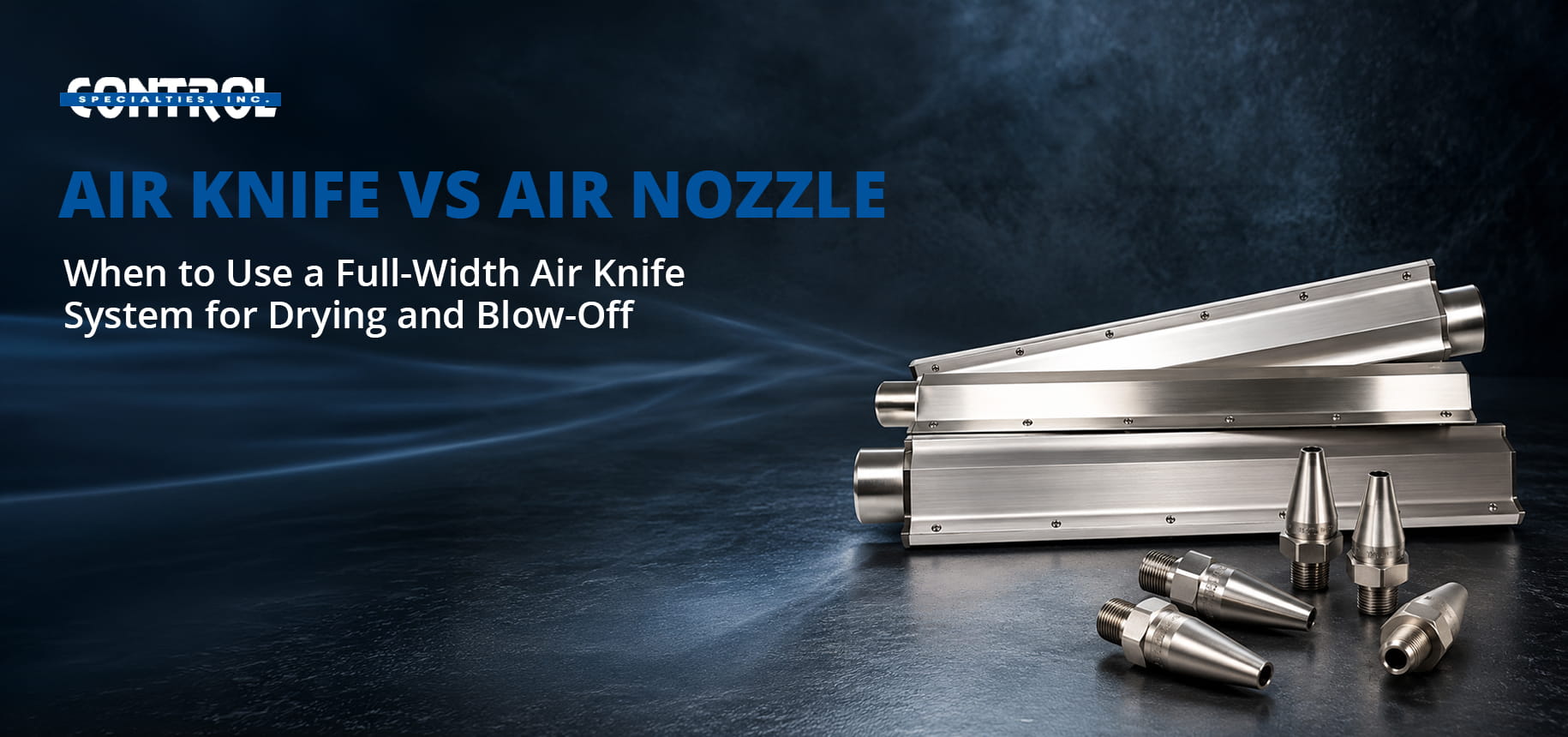
An air knife consists of an elongated and enclosed chamber, or plenum, with a narrow slot running along its length. Air enters the plenum and exits through the slot as a flat and high-velocity sheet.
Think of it as a squeegee made of air. As a product moves past the knife, the airstream removes water, coolant, dust, or debris without physical contact.
Air knives can range from a few inches to more than 16ft long. Republic Air Knives are available in extruded aluminum or stainless steel, with 2in, 3in, and 4in profiles and lengths up to 196in. Food-grade designs are also available to meet USDA and NSF requirements.
How Does an Air Knife System Work?
To understand how an air knife system works, break the system into three basic components:
| Component | Function |
|---|---|
| Air Source | Supplies air through a blower or plant compressed-air system. |
| Delivery Path | Uses hose or ducting to move air to the knife inlet. |
| Air Knife | Distributes air evenly and directs it through the slot onto the product. |
An adjustable slot can help fine-tune air velocity and volume for the application.
Blower-Powered vs. Compressed Air Knives
Air knives generally use one of two air sources. The choice depends on the required airflow, pressure, energy use, and available plant utilities.
Blower-Powered Air Knives
These systems deliver high air volume at relatively low pressure. Complete air knife systems can include a matched blower, filtered inlet, ducting, and knife. Republic systems are designed for applications such as liquid, dust, and debris removal before labeling, coding, or packaging.
Compressed-Air Knives
These connect directly to plant air and often use the Coanda effect to draw in surrounding air as the jet exits the knife. They're compact and don't require a dedicated blower, but their compressed-air consumption should be considered when evaluating operating costs.
| Feature | Blower-Powered | Compressed-Air |
|---|---|---|
| Air Source | Centrifugal or regenerative blower | Plant compressed air |
| Typical Pressure | About 1.5psi – 4psi | About 20psig – 100psig |
| Air Volume | High | Lower input volume with entrained air |
| Slot | Wider | Very narrow |
| Best Suited For | Continuous full-width drying and high-volume blow-off | Compact and targeted blow-off applications |
| Utility Requirement | Dedicated blower | Existing compressed-air supply |
For Continuous Full-Width Drying
Blower-powered air knives are often a practical choice because they provide high airflow without relying entirely on the plant's compressed-air supply. This makes them particularly relevant for high-volume drying and blow-off applications.
When to Use an Air Knife
An air knife is a good fit when you need consistent and full-width airflow across a moving product or continuous material. Consider an air knife when your process has one or more of these requirements:
- Wide Product Coverage: Products span most of the conveyor width, such as rows of cans, sheets, panels, or trays.
- Consistent Drying or Cleaning: Streaks, wet bands, or missed areas appear between individual air nozzles.
- High Line Speeds: Products move quickly, leaving limited dwell time for drying or blow-off.
- Continuous Operation: The process runs for extended periods or multiple shifts and requires repeatable airflow.
- Clean Air Requirements: The application requires clean and oil-free air, such as for food, pharmaceutical, or pre-paint processes.
An air knife is most useful when uniform coverage, repeatable results, and continuous operation matter more than directing airflow at a small and specific area.
Air Nozzle: An Overview
What is an Air Nozzle?
An air nozzle is a compact device that connects to a compressed-air line and shapes airflow into a focused jet. The airflow pattern may be a concentrated round jet or a narrow and flat fan.
Engineered air nozzles replace open pipes, copper tubes, and drilled holes that waste air, generate excessive noise, and can create safety concerns when dead-ended against skin.
How Does an Air Nozzle System Work?
Some engineered air nozzles use air amplification. Precisely positioned orifices release a small amount of compressed air at high velocity, creating a low-pressure zone that entrains surrounding room air.
Some amplifying nozzles can move many times their compressed-air input, with certain designs entraining up to approximately 25 parts of ambient air for every part of compressed air. This provides focused blowing force while reducing air consumption and noise compared with open pipes.
| Nozzle Pattern | Typical Use |
|---|---|
| Round Jet | Pinpoint blowing and cleaning |
| Flat Fan | Narrow-area drying or cooling |
| Multiple Nozzles | Wider coverage from a manifold or header |
Popular options such as the Vortec Model 1200 Nozzle and Vortec Model 1201 Nozzle include relief paths to prevent dead-ending. This supports compliance with OSHA 29 CFR 1910.242(b), which requires air used for cleaning to be reduced to less than 30psi when dead-ended.
When to Use an Air Nozzle
Choose air nozzles when the target is small, specific, or difficult to reach:
- Internal Cleaning: Remove chips and coolant from blind holes, threads, and passages.
- Part Ejection: Move parts from dies, molds, or conveyors.
- Spot Drying or Cooling: Target areas such as welds, label panels, or sensor windows.
- Intermittent Operation: Apply air only when a part is present.
- Quick Retrofits: Add focused airflow to an existing compressed air line.
For these applications, Vortec products from the Vortec company are a practical fit. The same brand page also includes cold air guns and vortex enclosure coolers for plant cooling applications.
Air Knife vs. Air Nozzle: Key Differences to Consider
The right blow-off device depends on the surface being treated, which requires understanding airflow pattern, operating distance, energy source, and production requirements. Here are the key differences to consider:
1. Coverage
- Air Knife: Creates a continuous curtain of air along its length, making it suitable for treating wide surfaces without leaving untreated areas between individual air streams.
- Air Nozzle: Produces a focused jet or narrow fan of air. Multiple nozzles can extend coverage, but spacing between them may result in less uniform airflow.
The Verdict
For continuous and full-width coverage, an air knife provides a more consistent solution. Nozzles are better suited to localized blow-off.
2. Operating Distance
- Air Knife: Performs best when positioned close to the product, typically within about 5in. Keeping the outlet near the surface helps maintain the strength and consistency of the air curtain.
- Air Nozzle: Delivers a concentrated stream that can remain effective over a greater distance, which is useful when the target is elevated, recessed, or otherwise difficult to position close to.
The Verdict
Short-range surface treatment favors an air knife, while applications requiring greater stand-off distance may benefit from a nozzle.
3. Part Geometry
- Air Knife: Works particularly well on flat, continuous, or consistently shaped products, such as sheets, webs, bottles, cans, and items moving along a conveyor.
- Air Nozzle: Directs airflow precisely into holes, pockets, recesses, edges, and other complex areas that may be difficult to reach with a broad air curtain.
The Verdict
Broad and accessible surfaces are a natural fit for an air knife. Complex shapes and confined targets call for the precision of a nozzle.
4. Air Source and Energy Use
- Air Knife: Blower-powered models use high-volume and low-pressure airflow, which may provide lower operating costs than plant compressed air in continuous applications. Options for compressed-air knives are also available where a blower isn't practical.
- Air Nozzle: Typically operates from a plant compressed air supply, providing strong localized airflow but potentially increasing energy costs when used continuously.
The Verdict
For sustained and high-volume blow-off, a blower-powered knife can offer a more economical operating profile. A nozzle makes more sense when airflow is limited to specific areas or shorter operating periods.
5. Up-Front Cost
- Air Knife: A complete blower-powered installation can require a greater initial investment because the system may include the knife, blower, ducting, controls, and mounting components.
- Air Nozzle: Initial equipment costs may be lower, particularly when an existing compressed air line can support the installation without additional equipment.
The Verdict
Nozzles generally offer a simpler, lower-cost installation, while an air knife can provide greater long-term value in continuous applications.
6. Airflow Control
- Air Knife: Delivers a uniform airstream along its full length, with the outlet gap and operating settings adjustable, where the design supports it, to match drying or blow-off requirements.
- Air Nozzle: Allows airflow to be aimed directly at individual targets. Nozzle position, orientation, and arrangement can be modified to address specific areas of a product.
The Verdict
An air knife offers consistent treatment across a defined width, whereas nozzles provide greater directional control for individual targets.
7. Installation and Retrofit Flexibility
- Air Knife: An air knife typically requires suitable mounting and, for blower-powered systems, space for the blower and ducting. This makes it well suited to purpose-built production lines with defined drying zones.
- Air Nozzle: Has a compact footprint and can often connect directly to an existing compressed air network. Multiple units can also be mounted on a manifold to address several blow-off points.
The Verdict
For a straightforward retrofit or space-constrained installation, nozzles offer greater flexibility. A dedicated air knife system is better suited to production lines that require consistent and full-width treatment.
Air Knife vs. Air Nozzle: A Side-by-Side Comparison
| Factor | Air Knife | Air Nozzle |
|---|---|---|
| Air Pattern | Continuous air curtain | Focused jet or flat fan |
| Coverage | Full-width and uniform coverage | Targeted and localized coverage |
| Target Distance | Best within about 5in | Effective at greater distances |
| Part Geometry | Flat or uniform surfaces | Complex or irregular parts |
| Air source | Blower or compressed air | Plant compressed air |
| Energy Use | Lower with blower-powered systems | Higher for continuous operations |
| Up-Front Cost | Higher system investment | Lower installation cost |
| Airflow Control | Consistent along full width | Precise directional control |
| Ideal Duty | Continuous drying and blow-off | Intermittent or spot blow-off |
| Best Applications | Bottles, cans, webs, sheets, and conveyors | Holes, recesses, edges, and small parts |
Air Knife Drying Applications
Air knives are suited for processes that require continuous and uniform airflow across a defined width. Their broad air curtain can remove surface moisture, debris, and excess coatings without requiring multiple individual blow-off points.
- Bottle and Can Drying: Removes water before labeling, coding, inspection, or packaging.
- Web Drying: Clears moisture from films, paper, foils, and other continuous materials.
- Conveyor Blow-Off: Removes water and debris from products moving at high speed.
- Coating Control: Helps remove excess liquid and maintain a more consistent coating thickness.
- Food and Beverage Processing: Provides full-width drying where cleanable and food-grade equipment is required.
- High-Speed Production: Maintains consistent blow-off across continuously moving products.
Air Nozzle Applications
Air nozzles are better suited to targeted blow-off, where airflow must reach a specific location or deliver concentrated force. Their compact design also makes them practical for retrofits and applications with limited installation space.
- Spot Blow-Off: Directs airflow precisely at a specific surface or area.
- Part Ejection: Moves lightweight components from one processing stage to another.
- Chip Clearing: Removes chips and debris from machined components and work areas.
- Hole and Recess Cleaning: Reaches openings, pockets, grooves, and other confined areas.
- Edge Drying: Removes moisture from product edges and hard-to-reach surfaces.
- Retrofit Applications: Adds targeted blow-off to existing compressed air systems without installing a complete air knife system.
When to Use a Full-Width Air Knife System
A full-width air knife system is ideal when a production line needs consistent airflow across the entire product width. It provides uniform drying and blow-off without relying on multiple individual air streams.
- Wide and Flat Products: Sheets, glass, film, panels, and webs benefit from uninterrupted airflow across the surface.
- Rows of Containers: Bottles, cans, and pouches moving several units across can be dried evenly before coding, labeling, or packaging.
- High-Speed Lines: A continuous air curtain provides consistent coverage when products move quickly through the drying zone.
- Coating Control: Uniform airflow can remove excess liquid and help maintain consistent coating thickness.
- Sanitary Applications: Filtered blower air and stainless steel knife designs can support applications with strict cleanliness and washdown requirements.
Rule of Thumb: Select a knife slightly wider than the product. About 2in of overhang on each side helps provide coverage at the edges as well as the center.
Can You Use an Air Knife and Air Nozzle Together?
Yes. An air knife can handle primary drying across the full product width, while targeted nozzles address areas that need additional airflow.
For example, a production line may use a full-width knife to remove most surface moisture, followed by one or two nozzles aimed at bottle caps, recessed labels, threaded holes, or part edges.
This combination balances coverage and precision. If a line consistently leaves moisture in one problem area, adding a targeted nozzle may be more practical than increasing the size of the blower system.
Control Specialties Can Help Find the Right Air Solution
The right blow-off method depends on what needs to be dried or cleared, how quickly the product moves, and how much coverage is required. Air knives provide a continuous air curtain for wide surfaces and high-speed lines, while air nozzles deliver focused airflow for specific areas. Combining both can provide broad coverage with targeted finishing where needed.
With decades of experience as an industrial equipment supplier, Control Specialties helps customers evaluate air, steam, water, and vacuum requirements for demanding applications. Our team can assess product geometry, airflow needs, operating conditions, installation constraints, and energy considerations to recommend a practical system.
If you're unsure which approach is right for your application, contact our experts to discuss your blow-off requirements with an experienced specialist and identify a solution suited to your production process.
Frequently Asked Questions (FAQs)
What is the difference between an air knife and an air nozzle?
An air knife produces a uniform sheet of air across a wide surface. An air nozzle delivers a concentrated jet to a specific spot. Knives suit conveyors and sheet material, while nozzles suit targeted parts or cavities.
When should I use an air knife instead of air nozzles?
Use an air knife when the target is wide, moves continuously on a conveyor, or needs streak-free coverage, such as drying bottles, blowing water off washed parts, or removing dust from film and sheet stock.
Is an air knife more energy efficient than air nozzles?
For wide-area tasks, usually yes. Engineered knives entrain large volumes of surrounding air, and blower-driven knives cost far less to run than compressed air. For small or intermittent spot jobs, a single engineered nozzle is often more efficient.
Compressed air knife vs. blower air knife: which is better for drying?
Compressed-air knives are compact and suit intermittent use or tight spaces. Blower knives cost more upfront but are much cheaper to run continuously, making them the better choice for high-volume and all-shift drying lines.
How far should an air knife be from the product?
Usually a few inches, since air velocity drops quickly with distance. Angle the knife roughly 30° – 45° against the direction of travel so water and debris are pushed off the part. Fine-tune for your line speed.
Are air knives quieter and safer than open air nozzles or pipes?
Yes. Engineered air knives are much quieter than open pipes or drilled tubes. Many designs also help meet OSHA 1910.242(b), which limits cleaning air to under 30psi dead-end pressure. Always check product noise ratings.
How do I size an air knife for my application?
Match the knife width to your product or conveyor, with slight overlap. Then factor in line speed, the task (drying or dust removal), daily run time, and whether both sides need treatment. Supplier testing can confirm the choice.
What information do I need to size an air knife blower?
To size an air knife blower, determine the required air knife length, slot opening, target air velocity, operating pressure, and number of knives. Also consider the application, material being processed, and available power supply to match the blower's airflow and pressure capacity.