
Table of contents
- What is an Air Nozzle?
- How Do Air Nozzles Work?
- What Are Air Nozzles Used For?
- Key Benefits of Using Engineered Air Nozzles
- Engineered Air Nozzles vs. Open Pipes: What Makes the Difference?
- How to Choose the Right Air Nozzle for an Application
- Air Nozzle Safety Tips for Industrial Applications
- 8 Common Mistakes When Using Air Nozzles
- How to Maintain Air Nozzles for Consistent Performance
- Improve Compressed-Air Performance With Control Specialties Air Nozzles
- Frequently Asked Questions (FAQs)
Compressed air is one of the most versatile utilities on a plant floor, but its effectiveness depends on how well the airflow is directed. This is where industrial air nozzles come in.
Rather than allowing compressed air to escape uncontrolled, a nozzle shapes and focuses airflow for specific tasks such as cleaning, drying, cooling, moving, or blowing off parts and surfaces.
An open pipe may seem like a simple alternative, but it can release air unevenly, consume more compressed air, and generate excessive noise. Engineered nozzles provide a more controlled airflow pattern for specific applications.
This blog explains how air nozzles work, common applications, efficiency benefits, safety considerations, and key factors for selecting the right nozzle.
What is an Air Nozzle?
An air nozzle is a device attached to the end of a compressed air line that shapes, directs, and controls airflow. Instead of releasing compressed air in a wide and unfocused burst, industrial air nozzles use internal geometry such as tapers, slots, holes, or vanes to create a controlled stream or fan of air for a specific task.
It helps to distinguish a few related terms:
- Standard/Open Air Outlets: The open end of a pipe or hose, without engineered airflow control.
- Engineered Air Nozzles and Compressed Air Nozzles: Purpose-built components designed for a specific force, airflow pattern, and noise level.
- Air Jets: Smaller and higher-velocity nozzles used for concentrated and spot applications.
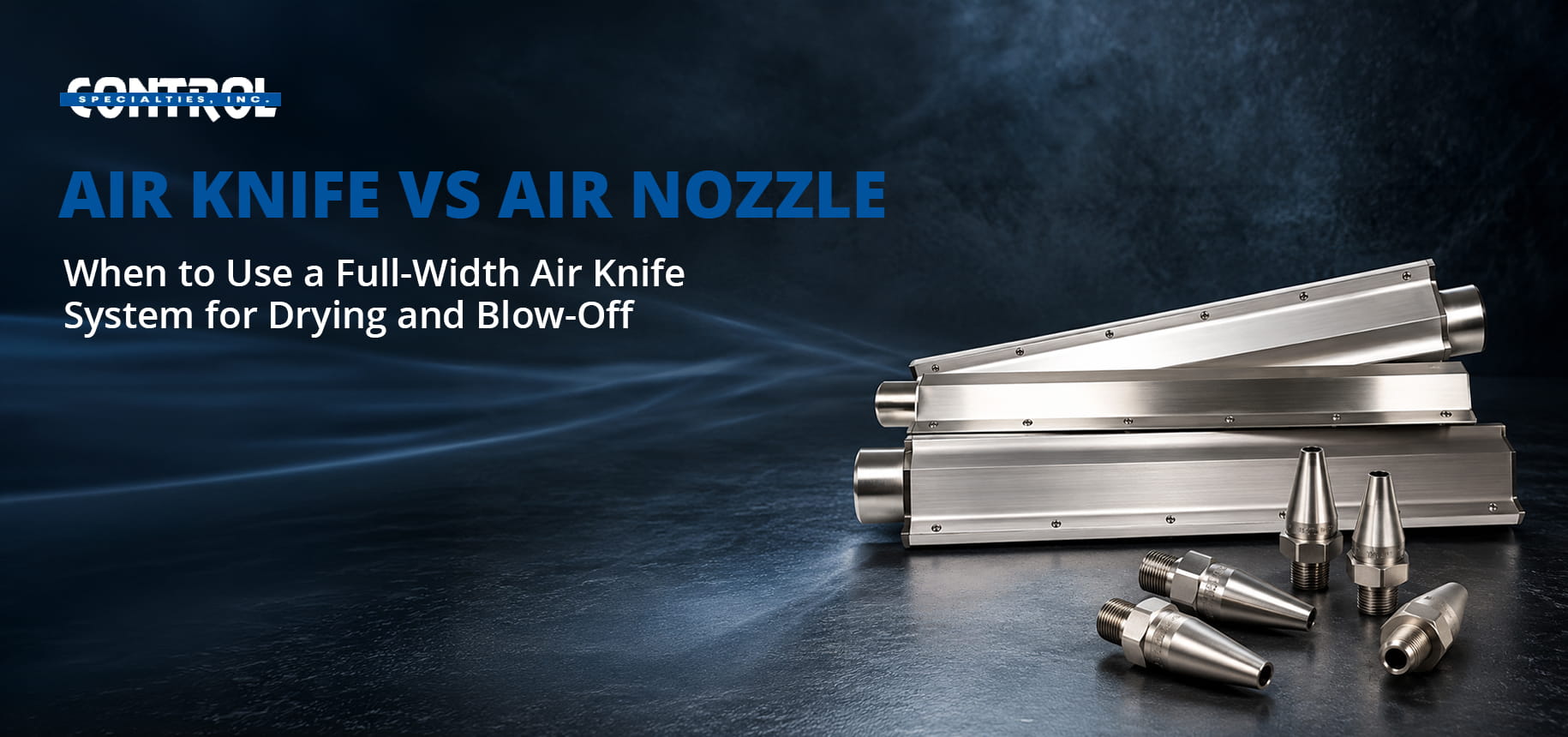
- Air Knives: Devices that produce a continuous and uniform sheet of air across a wider surface.
Many engineered nozzles also use air amplification, drawing surrounding ambient air into the discharge stream. This can increase airflow while using less compressed air than a comparable open outlet.
Control Specialties describes its Vortec nozzles and jets as using air amplification to produce powerful airflow while reducing compressed-air consumption.
Moreover, nozzle design directly affects velocity, coverage, sound level, and the amount of compressed air the system consumes, which makes nozzle selection important for both performance and efficiency.
How Do Air Nozzles Work?
Air nozzles control how compressed air exits a hose or pipe, converting the incoming air into a focused and useful airflow pattern.
Compressed Air Enters the Nozzle
Compressed air flows into the nozzle through a connected hose, pipe, or fitting.
Internal Geometry Shapes the Airflow
The nozzle's internal design directs and accelerates the air into a specific pattern, such as a narrow jet, wide fan, or full-coverage curtain.
Ambient Air May Be Entrained
In amplifying designs, the nozzle draws surrounding air into the discharge stream, increasing total airflow volume without a proportional increase in compressed-air consumption.
Targeted Airflow Performs the Task
The resulting airflow from compressed air nozzles delivers focused force to the work surface for applications such as blowoff, drying, cooling, or cleaning.
Increasing system pressure to compensate for a poorly matched nozzle can waste compressed air without solving the underlying performance problem. The right nozzle can deliver the required force and coverage more efficiently.
What Are Air Nozzles Used For?
So, what are air nozzles used for on a typical plant floor? They provide controlled airflow wherever a process needs to remove, move, cool, dry, or position materials. From production lines to packaging stations, the right nozzle can make compressed-air tasks more consistent and efficient.
Blowoff and Debris Removal
Blowoff is one of the most common uses for compressed air in manufacturing. Air blow off nozzles direct airflow across components to remove dust, metal chips, plastic shavings, and other loose debris before the next production step.
This is especially useful before:
- Painting: Removes particles that could affect surface finish.
- Assembly: Clears debris from mating surfaces and components.
- Inspection: Helps expose surfaces for more reliable visual checks.
- Packaging: Removes loose contaminants before products are packed.
Unlike an open pipe, a properly selected nozzle provides a controlled airflow pattern, helping deliver consistent blowoff while avoiding unnecessary air consumption and noise.
Drying Parts and Products
Water, oil, coolant, and cleaning solutions can remain on parts after washing or processing. Compressed air nozzles provide targeted airflow to remove this residual liquid before it creates downstream quality problems.
Common examples include:
- Washed metal components
- Molded plastic parts
- Glass containers
- Parts moving between cleaning and coating stages
Consistent airflow is important because uneven drying can leave moisture behind, potentially contributing to corrosion, contamination, or coating defects.
Cooling Components and Processes
Some production processes leave components too hot for immediate handling or the next manufacturing step. Industrial air nozzles provide localized airflow that can help dissipate heat from specific areas.
They can be useful after:
- Machining: Cooling freshly processed components.
- Molding: Reducing heat on molded parts.
- Welding: Helping cool localized hot areas.
- Curing: Supporting temperature reduction after heat-based processes.
Because the airflow can be directed precisely, a nozzle can provide targeted cooling where a general-purpose fan may not deliver sufficient coverage or control.
Moving or Ejecting Parts
Compressed air can also provide controlled movement without direct mechanical contact. These air nozzle applications are useful when lightweight parts need to be shifted, separated, or ejected during production.
For example, airflow can:
- Move lightweight components along a surface
- Eject finished parts from molds or fixtures
- Clear a workstation between production cycles
- Assist automated conveying or material handling
This makes air nozzles a practical option for simple and repeatable movements where mechanical handling may be unnecessary.
Cleaning Machinery and Work Areas
Air blow-off nozzles can help remove accumulated dust, chips, and residue from machinery and accessible work areas. They're commonly used around machine surfaces, fixtures, guards, and production stations.
However, cleaning applications require greater attention to airflow direction and operating conditions. The goal is to select the nozzle that delivers the required airflow with the greatest efficiency.
Air-Assisted Manufacturing Processes
Beyond cleaning, drying, cooling, and blowoff, air nozzle applications can support specific manufacturing operations where controlled airflow improves material handling or positioning.
Examples include:
- Separating stacked sheets before feeding them into a machine
- Positioning lightweight components during assembly
- Assisting conveying systems
- Providing localized airflow for process control
These applications often require a nozzle matched closely to the material, distance, airflow pattern, and required force. Using the wrong nozzle can result in inconsistent movement or unnecessary compressed-air consumption.
Key Benefits of Using Engineered Air Nozzles
Replacing an open pipe with an engineered nozzle can improve more than just blowoff performance. The right nozzle helps facilities use compressed air more effectively while improving control, consistency, and working conditions.
Reduced Compressed Air Consumption
Many engineered compressed air nozzles use air amplification to draw surrounding ambient air into the discharge stream. This can increase effective airflow without requiring a proportional increase in compressed-air demand.
The result can include:
- Lower compressed-air consumption
- Reduced compressor workload
- Lower operating costs
Actual savings depend on the application, operating pressure, nozzle design, and existing setup, so performance should be evaluated based on the specific blowoff task.
More Precise Airflow
An engineered nozzle directs airflow toward the target instead of allowing it to disperse unnecessarily around the work area. This can make cleaning, drying, and blowoff operations more controlled and repeatable.
For applications where airflow needs to reach a specific surface or area, nozzle geometry can determine how effectively the available compressed air is used.
Lower Noise Potential
Open pipes and improvised blowoff arrangements can generate significant noise on the plant floor. Many air blow off nozzles are designed with airflow and noise reduction in mind, helping reduce unnecessary sound at the point of use.
Lower noise can contribute to a more comfortable work environment while still providing the airflow required for the application.
Improved Process Consistency
A nozzle designed for a specific task provides a predictable airflow pattern and force. This is particularly valuable when blowoff or drying is part of a repeatable production process.
More consistent airflow can help:
- Produce more uniform cleaning results
- Improve drying performance
- Reduce process variation
- Support downstream quality control
Better Energy Efficiency at the Point of Use
Efficient airflow at the point of use is an important part of overall compressed-air management. Using properly sized industrial air nozzles can complement broader efficiency measures such as leak reduction, pressure optimization, and effective filtration.
For facilities looking at the bigger picture, Control Specialties' compressed-air guidance provides additional considerations for reducing waste throughout a compressed-air system.
Engineered Air Nozzles vs. Open Pipes: What Makes the Difference?
An open pipe or drilled tube may seem like a simple and low-cost way to create blowoff. However, it doesn't provide the same level of airflow control, efficiency, or consistency as an engineered nozzle.
| Factor | Engineered Air Nozzle | Open Pipe/Drilled Tube |
|---|---|---|
| Airflow Control | Targeted and application-specific | Less controlled |
| Air Consumption | Optimized for the application | Can be excessive |
| Noise | Can be designed for lower noise | Often higher |
| Blow Off Consistency | More predictable | Variable |
| Safety Considerations | Designed around specific performance characteristics | Greater risk if improperly used |
| Application Flexibility | Multiple nozzle designs available | Limited |
Why Engineered Nozzles Typically Perform Better
An open pipe may appear cheaper because it requires little more than a hose, pipe, or drilled tube. However, the initial cost doesn't tell the whole story.
An engineered nozzle can provide advantages in several areas:
- Better Airflow Control: Directs air toward the target instead of dispersing it.
- Potential Air Savings: Uses nozzle geometry to deliver the required airflow more efficiently.
- Lower Noise: Many designs are developed to reduce the noise associated with compressed-air blowoff.
- More Consistent Results: Provides a repeatable airflow pattern for production tasks.
- Better Application Matching: Different nozzle designs can address different airflow, coverage, and force requirements.
These factors are especially important when evaluating what air nozzles are used for and whether an engineered solution is appropriate for a particular process.
Match the Nozzle to the Application
There is no single nozzle design that works equally well for every task. The right choice depends on the required force, coverage, distance, operating pressure, and target material.
Matching the nozzle to its intended air nozzle applications is therefore more important than simply using whatever fitting is available. A properly matched nozzle can improve performance while helping control compressed-air use, noise, and operating costs.
How to Choose the Right Air Nozzle for an Application
The right nozzle should match the actual requirements of the process; not simply deliver the highest possible airflow. Consider these factors before specifying compressed air nozzles for a production or maintenance application.
1. Required Airflow and Blowoff Force
Start with the result you need from the nozzle. Determine whether the task requires light debris removal, aggressive blowoff, drying, cooling, or another type of directed airflow.
More pressure isn't automatically better. An oversized nozzle can consume additional air and create more noise without delivering a meaningful improvement in performance.
2. Operating Pressure
Check the pressure available at the point of use, rather than relying only on compressor discharge pressure.
Pressure losses through piping, hoses, fittings, filters, and other components can reduce the pressure reaching the nozzle. Make sure the selected nozzle can perform effectively at the pressure actually available.
3. Air Consumption and Duty Cycle
Review the nozzle's air consumption alongside the facility's available compressed-air capacity. The operating schedule matters, too.
A station using air blow off nozzles continuously can have a much greater impact on air demand than a nozzle used for a few seconds during an occasional maintenance task.
Consider:
- Required airflow
- Operating pressure
- Number of nozzles
- Continuous vs. intermittent operation
4. Target Area and Airflow Pattern
Consider the size and shape of the area that needs airflow. The air nozzle applications may require either a concentrated stream for a specific spot or broader coverage across a larger surface.
Depending on the task, the better solution may be:
- A single focused nozzle
- Multiple nozzles
- A wider-pattern nozzle
- An air knife for continuous coverage
5. Material and Environmental Conditions
The operating environment can affect nozzle performance and service life. Consider exposure to:
- High or low temperatures
- Moisture
- Dust and other contaminants
- Chemicals or corrosive conditions
For demanding environments, stainless steel or other corrosion-resistant construction may be more appropriate.
6. Noise Requirements
Consider what air nozzles are used for in the specific work area and how frequently they operate. Noise becomes particularly important when several nozzles run continuously near employees.
Evaluate the nozzle's sound characteristics along with operating pressure and the surrounding equipment to help maintain an acceptable workplace environment.
7. Installation and Connection Requirements
Finally, make sure the nozzle physically fits the application. Check the available space, mounting position, connection type, and pipe or hose size before ordering.
A nozzle can meet the required airflow and pressure specifications but still be unsuitable if it cannot be installed correctly or positioned effectively.
The goal isn't simply to select the most powerful nozzle. It's to match airflow, force, coverage, efficiency, noise, and installation requirements to the actual job.
Air Nozzle Safety Tips for Industrial Applications
Compressed air can deliver significant force, so air blow off nozzles should be treated as industrial equipment, not as general-purpose cleaning tools.
Safe operation depends on the right nozzle, proper pressure, suitable PPE, and control of the material being blown off.
Never Direct Compressed Air Toward People
Never direct compressed air toward the eyes, ears, skin, or other parts of the body. Improper use can cause serious injuries.
For cleaning applications where compressed air is discharged against the human body, OSHA requires pressure to be less than 30 psi and effective safeguards such as pressure-reducing features or chip guarding.
When considering how to use air nozzles safely, engineered nozzles are preferable to unrestricted open pipes.
Use Nozzles Designed for Safe Blowoff
Avoid improvised nozzles, modified fittings, and unrestricted open pipes. Use equipment designed for the required pressure and application.
A purpose-built nozzle can provide better airflow control while helping address noise and exposure concerns.
Control Operating Pressure
Keep operating pressure within the manufacturer's specified range.
Avoid increasing pressure simply to compensate for a poorly matched nozzle. Higher pressure can increase:
- Compressed-air consumption
- Noise
- Operating costs
- Safety exposure
Wear Appropriate PPE
The required PPE depends on the application and the material being removed.
- Eye Protection: For airborne particles and debris
- Hearing Protection: Where compressed-air noise requires it
- Additional PPE: For dust, chemicals, chips, or other hazardous materials
Secure the Nozzle and Connections
Inspect the nozzle, hose, fittings, and mounting hardware before use.
Look for:
- Loose connections
- Damaged hoses
- Worn fittings
- Improper mounting
A pressurized hose or fitting that fails can move unexpectedly and create a serious hazard.
Consider What You Are Blowing Off
The material being removed can create a secondary hazard when it becomes airborne. Fine dust, chemical residue, and metal particles may require additional controls.
Depending on the application, consider:
- Local exhaust or extraction
- Containment
- Appropriate filtration
- An alternative cleaning method
Safe air nozzle applications should control both the compressed-air discharge and the material being displaced.
8 Common Mistakes When Using Air Nozzles
Even well-designed compressed air nozzles can perform poorly when they're incorrectly selected, installed, or operated. Avoid these common mistakes to improve performance and control compressed-air costs.
- Excessive Pressure: Higher pressure can increase air consumption and noise without improving blowoff performance.
- Wrong Connection-First Selection: A nozzle that fits the hose may not fit the application. Consider airflow, force, coverage, and pressure.
- Incorrect Airflow Pattern: Different air nozzle applications need different airflow patterns. A focused jet may not provide enough coverage for wider surfaces.
- Ignoring Air Consumption: Continuous operation can make small amounts of wasted air costly. Consider pressure, operating hours, and duty cycle.
- Excessive Nozzle Distance: A nozzle positioned too far from the target may lose effectiveness and encourage unnecessary pressure increases.
- Too Many Nozzles: Multiple air blow off nozzles aren't always better. An air knife may provide more uniform coverage across wide surfaces.
- Poor Nozzle Maintenance: Blockages, damage, and worn connections can reduce airflow and affect performance.
- Ignoring Air Costs: Inefficient industrial air nozzles and unnecessary operating time can increase compressed-air costs.
How to Maintain Air Nozzles for Consistent Performance
Even a well-selected nozzle requires routine inspection and maintenance to maintain consistent airflow, performance, and efficiency.
- Check for Blockages: Inspect nozzle openings regularly for dust, debris, or other contamination that could restrict airflow.
- Inspect Connections: Check fittings and connections for leaks that can waste compressed air and reduce blowoff force.
- Verify Pressure: Periodically confirm that operating pressure remains within the manufacturer's recommended range.
- Monitor Performance: Watch for changes in airflow pattern, force, or blowoff results that may indicate nozzle wear or blockage.
- Inspect Hoses and Fittings: Look for cracks, wear, loose connections, or other signs of damage.
- Clean as Recommended: Follow the manufacturer's cleaning instructions to avoid damaging the nozzle or changing its airflow characteristics.
- Replace Damaged Nozzles: Replace damaged components rather than drilling, modifying, or altering the nozzle in the field.
- Review Overall Air Use: If compressed-air consumption increases unexpectedly, consider a system assessment to identify leaks, worn nozzles, or oversized equipment.
Improve Compressed-Air Performance With Control Specialties Air Nozzles
Choosing the right nozzle can improve blowoff, drying, cooling, and cleaning performance while helping control compressed-air use, noise, and operating costs. The best results come from matching the nozzle to the required airflow, pressure, force, coverage, and operating environment. Maintaining clean and dry air and addressing leaks and pressure losses can further support reliable performance.
Control Specialties offers compressed air solutions, including ITW Vortec air nozzles and air jets for industrial blowoff, drying, cooling, and cleaning applications. Supporting components such as air compressor filters and Condensate Drain Trap can also help maintain efficient air delivery.
If you're evaluating air nozzles for your facility, Get in touch with our specialists to discuss your application and get guidance on the right nozzle for your airflow, pressure, and performance requirements. Our specialists can help evaluate your airflow requirements, operating pressure, duty cycle, and application to recommend the most effective nozzle for your process.
Frequently Asked Questions (FAQs)
Can an air nozzle replace a compressed-air blow gun?
For fixed production applications, an engineered air nozzle can provide more consistent airflow and easier integration than a handheld blow gun. The better option depends on whether the task is manual, automated, intermittent, or continuous.
How can I tell if my air nozzle is wasting compressed air?
Unexpectedly high compressor demand, excessive noise, weak blowoff, or inconsistent performance can indicate an inefficient nozzle. Compare actual airflow consumption with the nozzle's specifications and check for leaks, blockages, or excessive operating pressure.
Should I use one air nozzle or multiple nozzles?
The answer depends on the target area's size, shape, and required airflow pattern. A focused task may need one nozzle, while wider coverage may require multiple nozzles or an air knife for more uniform airflow.
Can air nozzles be used in automated production lines?
Yes. Engineered nozzles are commonly integrated into automated blowoff, drying, cooling, conveying, and part-ejection systems. Selection should account for cycle time, mounting position, operating pressure, airflow requirements, and the distance to the target.
What should I check before replacing an existing air nozzle?
Review the current nozzle's airflow, operating pressure, air consumption, connection size, mounting position, noise level, and application requirements. This helps ensure the replacement improves performance rather than simply replicating the existing setup.
Should I use stainless steel or brass air nozzles?
Stainless steel air nozzles suit corrosive, high-temperature, or washdown environments, while brass works well for general industrial applications. Consider the operating environment, temperature, moisture, chemical exposure, durability requirements, and overall installation cost before deciding.
Do all engineered air nozzles use air amplification?
No. Not all engineered air nozzles use air amplification. Some designs rely primarily on controlled airflow and optimized nozzle geometry. Air-amplifying models entrain surrounding air to increase output volume while reducing compressed-air consumption.
Can air nozzles reduce compressor wear?
Yes. Properly engineered air nozzles can reduce compressed-air consumption, lowering the demand placed on a compressor. Reduced operating demand may decrease compressor runtime, cycling, and energy consumption, potentially supporting longer equipment life and lower maintenance costs.