Table of contents
- Understanding Moisture in Compressed Air Systems
- Condensate Drain Traps: The Frontline of Moisture Management
- Compressed Air Leaks: The Invisible Energy Drain
- Pressure Drops: How Distribution Design Wastes Energy
- End-Use Efficiency: Where Compressed Air Meets the Process
- Flow Monitoring: You Can't Manage What You Can't Measure
- Common Causes of Compressed Air Waste and How to Fix Them
- What Should a Compressed Air Audit Include?
- Improve Compressed Air Efficiency with Control Specialties
- Frequently Asked Questions (FAQs)
Compressed air is often called the "fourth utility" because it powers critical operations across manufacturing facilities. Yet it's also one of the most expensive and frequently wasted resources on the plant floor.
According to the U.S. Department of Energy, compressed air systems can account for up to 30% of industrial electricity consumption, with significant losses caused by leaks, pressure drops, poor condensate management, and inefficient use of compressed air drain traps.
These hidden inefficiencies can add thousands of dollars to annual operating costs while reducing system reliability and performance. The good news is that many of these issues are preventable with the right approach.
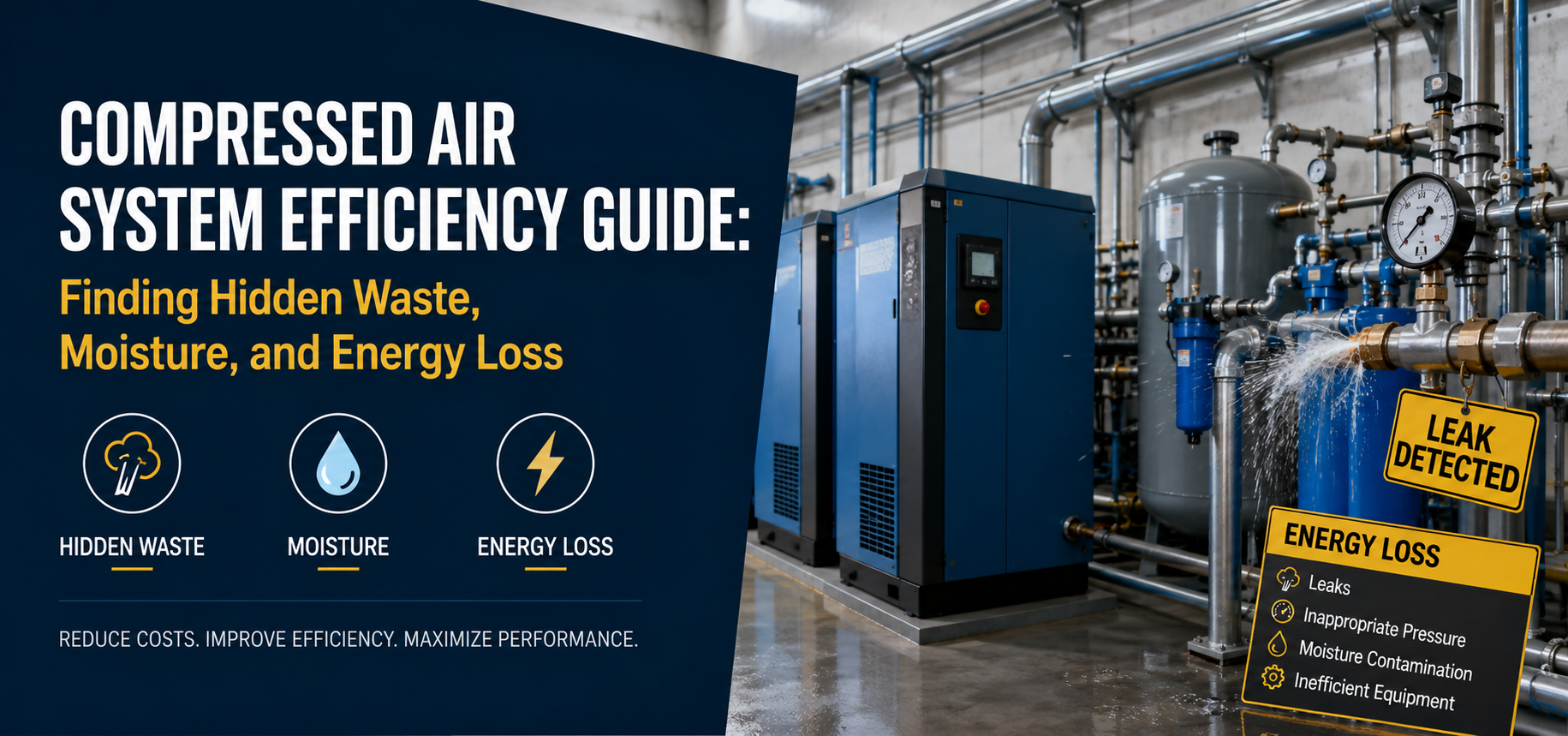
Improving compressed air efficiency starts with identifying where energy and performance losses occur. By addressing problems such as condensate buildup, air leaks, pressure drops, and excessive air consumption, facilities can reduce operating costs and improve system reliability.
Understanding Moisture in Compressed Air Systems
Moisture is one of the most common and costly challenges in compressed air systems. If left unmanaged, condensate can reduce efficiency, increase maintenance requirements, damage equipment, and shorten the lifespan of critical components throughout the air network.
How Does Moisture Form in Compressed Air Systems?
The air drawn into a compressor naturally contains water vapor. During compression, the air temperature rises significantly, allowing moisture to remain suspended in the air stream. As the compressed air cools while moving through receivers, piping, and production equipment, the vapor condenses into liquid water.
Several factors contribute to increased condensate formation:
- High humidity levels
- Long piping runs
- Temperature fluctuations within the facility
- Insufficient drying or compressed air drain traps
This means that even systems producing relatively dry air at the compressor can experience significant moisture accumulation further downstream.
The Hidden Cost of Moisture and Condensate
Excess moisture does far more than collect in air lines; it impacts system performance, equipment reliability, and operating costs.
Common consequences include:
- Corrosion of pipes, valves, and fittings
- Premature wear of pneumatic tools and equipment
- Product contamination in sensitive manufacturing processes
- Reduced airflow due to saturated filter elements
- Increased maintenance and disposal costs associated with condensate
Effective moisture management begins with proper filtration. Well-maintained air compressor oil filters help remove contaminants before they reach downstream equipment, protecting both air quality and system performance.
Condensate Drain Traps: The Frontline of Moisture Management
Once moisture enters a compressed air system, it must be removed before it can damage equipment, reduce efficiency, or contaminate processes. This is where condensate drain technology becomes critical. Proper condensate removal helps protect system components, maintain air quality, and prevent unnecessary energy losses.
Why are Drain Traps Important?
Compressed air drain traps are designed to automatically remove accumulated water and oil from air receivers, filters, dryers, and low points throughout the distribution system. Their primary purpose is to eliminate condensate while preventing the loss of valuable compressed air.
When drain traps fail, the consequences can be costly:
- Failed-open drains continuously release compressed air, increasing energy consumption
- Failed-closed or clogged drains allow condensate to accumulate within the system
- Excess moisture accelerates corrosion and equipment wear
- Water contamination can damage downstream processes and products
- Poor condensate management increases maintenance requirements and downtime
Because of their direct impact on both energy efficiency and equipment reliability, drain traps should be inspected and maintained as part of every compressed air maintenance program.
Common Types of Condensate Drain Traps
Different applications require different drain technologies. The most common options include:
- Timer-Controlled Drains: Open at preset intervals and durations. While affordable, improper settings can either waste compressed air or leave condensate behind.
- Float-Operated Drains: Activate when condensate reaches a specific level. They're efficient but may require more maintenance in systems with oil-heavy condensate.
- Electronic Level-Sensing Drains: Use sensors to discharge condensate only when necessary, helping minimize air loss and improve efficiency.
- Zero-Air-Loss Drains: Designed to remove condensate without releasing compressed air, making them one of the most energy-efficient solutions available.
Selecting the right drain technology can significantly improve system performance while reducing operating costs.
Drain-All®: A Reliable Condensate Management Solution
For facilities seeking dependable automatic condensate removal, Drain-All systems provide a proven solution. Designed for demanding industrial environments, these units efficiently handle condensate from compressors, receivers, dryers, and distribution piping while minimizing maintenance requirements.
To ensure long-term performance, facilities should regularly inspect and replace worn drain parts as needed. Maintaining drain assemblies in peak condition helps prevent moisture-related issues, protects air quality, and supports overall compressed air system efficiency.
Compressed Air Leaks: The Invisible Energy Drain
Even the most efficient compressed air system can become a major source of wasted energy if leaks go undetected. Because compressed air leaks are often difficult to see or hear, they can persist for months or even years, quietly increasing energy costs and forcing compressors to work harder than necessary.
How Much Energy do Compressed Air Leaks Waste?
Air leaks are one of the leading causes of compressed air inefficiency. Industry studies show that a well-maintained system typically maintains leak rates below 10%, while many facilities operate with losses of 20% - 30% and sometimes even more.
The financial impact can be significant. Even a small leak can waste thousands of dollars in electricity annually while reducing available air pressure throughout the system. As leaks multiply across a facility, they place an additional strain on compressors, increase operating costs, and shorten equipment life.
Where do Compressed Air Leaks Commonly Occur?
Leaks can develop anywhere compressed air is generated, distributed, or used.
Common leak points include:
- Threaded pipe connections with deteriorated sealant
- Push-to-connect fittings with worn inserts
- Flexible hoses and couplings with damaged seals
- Pressure regulators with aging internal components
- Pneumatic cylinders with worn rod seals
- Control valves with damaged seats or stems
- Quick-connect couplings that no longer seal properly
Even minor leaks at multiple locations can collectively create substantial energy losses.
How to Conduct an Effective Leak Audit
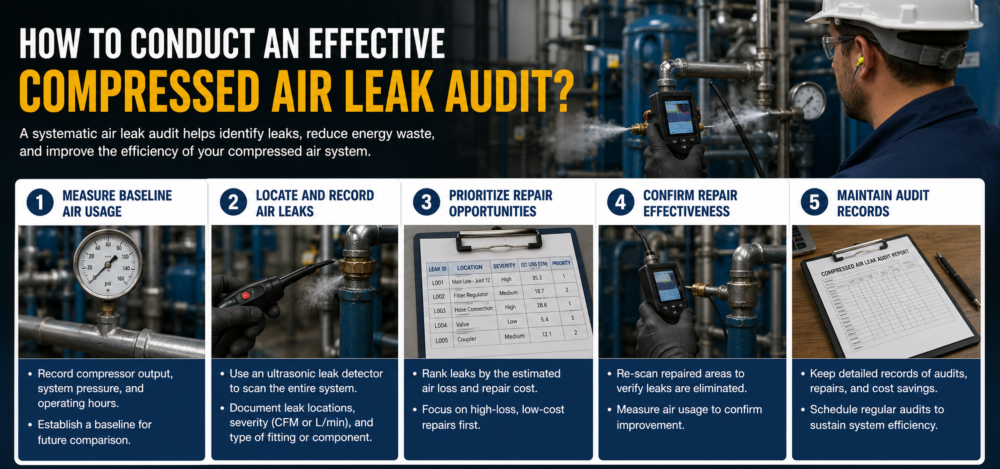
Finding and eliminating leaks requires a structured approach. Ultrasonic leak detectors are often the preferred solution because they can identify escaping air even in noisy production environments.
A comprehensive leak audit should include:
- Establishing a baseline by measuring the compressor performance during non-production hours
- Inspecting the distribution system to identify and document leak locations
- Prioritizing repairs based on leak severity and potential energy savings
- Verifying results after repairs to confirm reduced air consumption
- Maintaining records to track recurring issues and support future audits
Facilities that routinely perform leak audits often achieve some of the fastest returns on investment available in a compressed air optimization program. When combined with properly maintained compressed air drain traps and filtration systems, leak reduction efforts can significantly improve overall system efficiency and operating costs.
Pressure Drops: How Distribution Design Wastes Energy
Pressure drop is one of the most overlooked causes of compressed air inefficiency. As air travels through the distribution network, restrictions, moisture buildup, and poorly maintained compressed air drain traps can reduce pressure before it reaches production equipment.
To compensate, operators often increase compressor discharge pressure, driving up energy consumption and operating costs.
The 1 PSI (Pounds per Square Inch) Rule
A widely accepted rule in compressed air management is that for every 1 PSI increase in operating pressure, approximately 0.5% more energy is required to produce. While that may seem minor, the impact adds up quickly across an entire facility.
For example, if a compressor must operate at 110 PSI to deliver 90 PSI at the point of use, the additional energy required is often the result of avoidable pressure losses within the distribution system. Reducing these losses can improve efficiency without compromising production performance.
Common Causes of Pressure Drop
Several factors contribute to excessive pressure loss throughout a compressed air system:
- Undersized piping that creates excessive air velocity and friction
- Excessive elbows, tees, valves, and other flow restrictions
- Dirty or saturated filter elements
- Long distribution runs with inadequate system design
- Condensate accumulation in piping low points
- Internal pipe corrosion that increases airflow resistance
Even small restrictions can compound across the system and create significant energy penalties.
How to Reduce Pressure Drop
Improving pressure performance starts with identifying where losses occur. Compare pressure readings at the compressor discharge point and at critical end-use locations to determine the extent of system losses.
Key corrective actions include:
- Replacing clogged or saturated filter elements
- Verifying pipe sizing against current airflow requirements
- Removing unnecessary restrictions within the distribution network
- Eliminating condensate buildup through proper drainage
- Repairing or replacing aging piping infrastructure
One of the fastest and most cost-effective improvements is maintaining filtration equipment. Regular inspection and replacement of air compressor oil filters helps minimize airflow restrictions, improve air quality, and reduce unnecessary pressure losses throughout the system.
End-Use Efficiency: Where Compressed Air Meets the Process
Even a well-maintained compressed air system can waste significant energy at the point of use. Inefficient blowoff, cooling, drying, and cleaning applications often consume more compressed air than necessary, increasing operating costs while delivering inconsistent performance.
Optimizing end-use equipment is one of the most effective ways to improve overall system efficiency.
Problems with Open-Blow Applications
Open-blow applications use compressed air through drilled holes, open pipes, or improvised outlets to clean, cool, or dry products. While simple to implement, these setups are highly inefficient and often generate excessive noise.
Common drawbacks include:
- Excessive compressed air consumption
- Higher operating costs
- Inconsistent airflow performance
- Increased workplace noise levels
- Potential safety and compliance concerns
Replacing these setups with engineered air nozzles can significantly improve efficiency. Designed to maximize airflow while minimizing compressed air usage, engineered nozzles often reduce air consumption by approximately 30%-50%. They also help lower noise levels and provide more controlled, effective blowoff performance by entraining surrounding ambient air into the airflow stream.
Why Air Knife Systems Deliver Better Performance
For applications requiring continuous airflow across wide surfaces, air knife systems offer a more efficient and consistent solution than drilled-pipe manifolds or multiple individual nozzles.
A properly designed air knife produces a uniform, high-velocity sheet of air across its entire length, delivering better coverage while using less compressed air. This combination of efficiency and performance makes air knives a preferred choice for many industrial processes.
Common applications include:
- Bottle and container drying before labeling
- Web, film, and sheet drying operations
- Parts washing and drying systems
- Food processing moisture removal
- Conveyor cleaning and debris removal
Facilities that upgrade from improvised blowoff methods to engineered air knife systems often achieve substantial energy savings, improved product quality, and rapid returns on investment.
Flow Monitoring: You Can't Manage What You Can't Measure
Improving compressed air efficiency starts with understanding how air is being used throughout the system. Without accurate flow data, it's difficult to identify leaks, detect abnormal consumption patterns, measure the impact of efficiency upgrades, or verify energy savings.
Effective monitoring turns compressed air management from a reactive process into a proactive strategy.
Why Flow Metering Matters
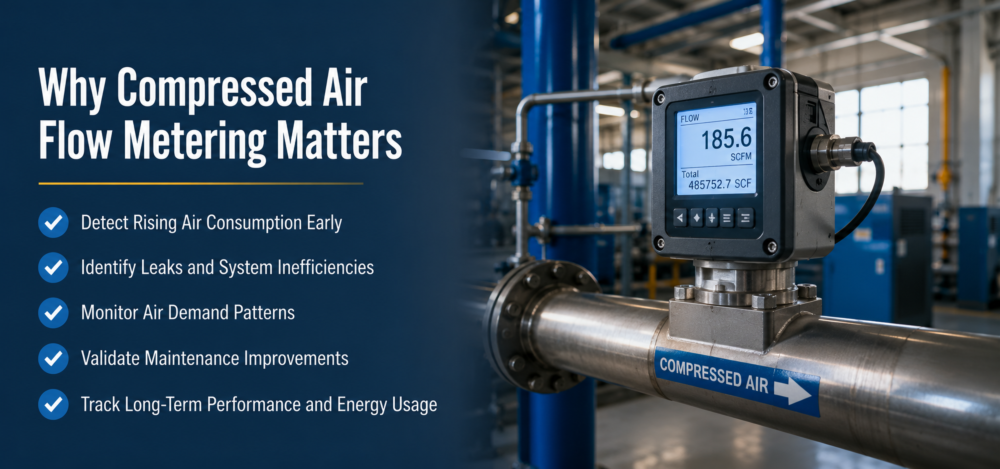
Many common compressed air issues develop gradually and often go unnoticed until they affect production or increase operating costs. Flow monitoring helps facilities gain visibility into system performance and make informed decisions based on real data.
With proper flow measurement, operators can:
- Identify unexpected increases in air consumption
- Detect leaks and system inefficiencies more quickly
- Monitor demand during production and non-production hours
- Verify the effectiveness of maintenance and optimization efforts
- Track long-term system performance and energy usage
This visibility allows facilities to prioritize improvements and maximize the return on efficiency investments.
The Benefits of Clamp-On Flow Monitoring
Traditional flow meter installations often require pipe modifications, production downtime, and additional installation costs. A keyence clamp-on flow meter offers a non-invasive alternative by mounting externally on existing piping, eliminating the need to cut into the compressed air system.
Using ultrasonic technology, clamp-on flow meters measure flow through the pipe wall while allowing operations to continue uninterrupted.
These meters are particularly useful for:
- Temporary measurements during compressed air audits
- Permanent monitoring at critical system locations
- Retrofit projects where traditional meters are impractical
- Comparing compressor output to actual distribution demand
By providing real-time visibility into airflow and consumption patterns, a keyence clamp-on flow meter helps facilities uncover hidden inefficiencies, validate improvement efforts, and make smarter decisions about compressed air system performance.
Common Causes of Compressed Air Waste and How to Fix Them
Compressed air inefficiencies rarely stem from a single issue. In most facilities, energy losses are caused by a combination of leaks, moisture problems, pressure drops, inefficient end-use applications, and a lack of system visibility. Identifying and addressing these issues systematically can significantly reduce operating costs while improving reliability and productivity.
The table below highlights some of the most common sources of compressed air waste, their typical impact on system performance, and the corrective actions that can help improve efficiency.
| Efficiency Loss Type | Typical Impact | Common Cause | Recommended Solution |
|---|---|---|---|
| Air Leaks | 5%-30% of compressed air output is lost | Worn fittings, damaged hoses, and faulty connections | Perform regular leak audits and repair or replace defective components |
| Condensate Buildup | Reduced efficiency and increased maintenance | Excess moisture accumulating in receivers, filters, and piping | Install and maintain automatic compressed air drain traps and moisture control equipment |
| Pressure Drops | Increased energy consumption and reduced performance | Undersized piping, clogged filters, and excessive restrictions | Optimize piping design and maintain filtration systems |
| Inefficient End-Use Applications | Excessive compressed air consumption | Open-blow devices and outdated blowoff methods | Upgrade to engineered air nozzles or air knife systems |
| Unmonitored Airflow | Hidden waste and undetected system issues | Lack of flow measurement and performance data | Implement monitoring with a Keyence clamp-on flow meter |
| Poor Filtration | Contamination, pressure loss, and equipment wear | Saturated or neglected air compressor oil filters | Establish a routine inspection and filter replacement schedule |
What Should a Compressed Air Audit Include?
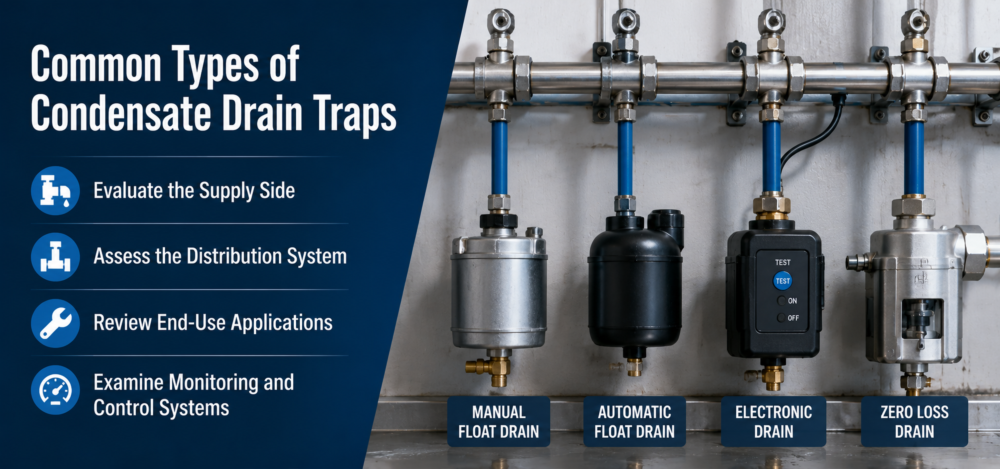
A compressed air audit is one of the most effective ways to uncover hidden inefficiencies, reduce energy costs, and improve system reliability. By evaluating the entire system from air generation to end-use applications, facilities can identify opportunities for improvement and prioritize corrective actions based on operational impact and return on investment.
Evaluate the Supply Side
The audit should begin with a detailed assessment of the air generation equipment to determine whether the system is operating efficiently and meeting actual demand.
Key areas to review include:
- Compressor type, age, and operating condition
- Rated output compared to actual air delivery
- Compressor loading and unloading patterns
- After a cooler and drier performance
- Condition of filtration equipment, including air compressor oil filters
- Pressure losses across filters and treatment components
Assess the Distribution System
The distribution network plays a major role in overall efficiency. Even a well-performing compressor can lose significant energy through leaks, restrictions, and poor condensate management.
Important inspection points include:
- Pipe sizing and distribution layout
- Pressure measurements throughout the system
- Leak detection using ultrasonic testing equipment
- Verification of proper operation for compressed air drain traps
- Areas where condensate accumulation may restrict airflow
Review End-Use Applications
Evaluating how compressed air is consumed often reveals some of the largest opportunities for savings.
The audit should identify:
- All compressed air-powered equipment and processes
- Open-blow applications and other inefficient air usage
- Opportunities to upgrade to engineered air nozzles or air knife systems
- Actual pressure requirements versus delivered pressure
- Sources of artificial demand caused by excessive operating pressure
Examine Monitoring and Control Systems
Effective monitoring provides the visibility needed to sustain long-term efficiency improvements.
Areas to evaluate include:
- Existing airflow measurement capabilities
- System pressure control strategies
- Air storage capacity and utilization
- Opportunities for demand-based control and scheduling
- Potential benefits of installing a Keyence clamp-on flow meter for ongoing performance monitoring
A comprehensive audit provides the data needed to make informed decisions, prioritize projects, and build a structured roadmap for improving compressed air system performance. Facilities that regularly assess their systems are better positioned to reduce operating costs, improve reliability, and achieve long-term energy savings.
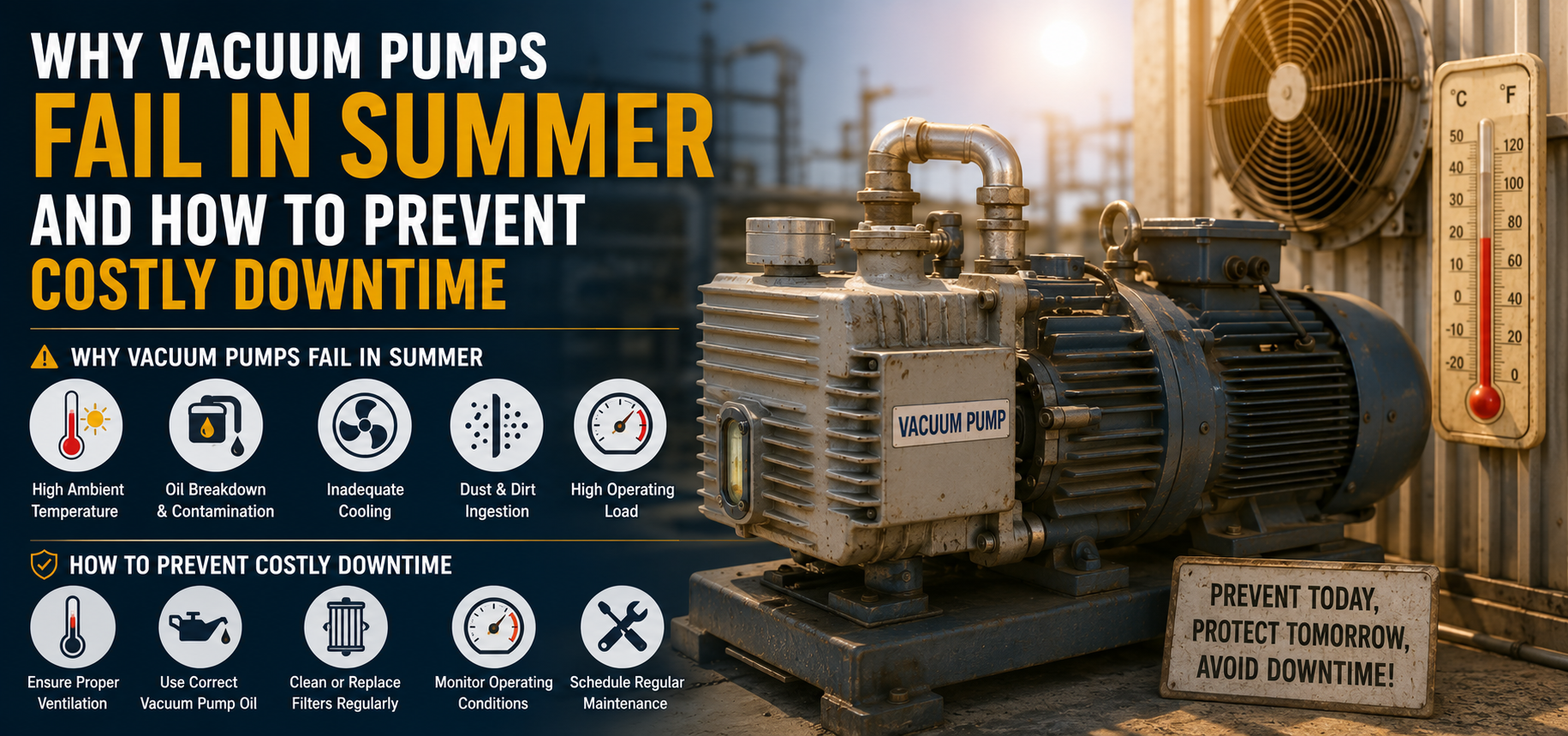
Compressed air efficiency is closely tied to overall pneumatic system reliability. Facilities that rely on both compressed air and vacuum equipment should also understand the impact of seasonal operating conditions. Learn more in our related guide: Why Vacuum Pumps Fail in Summer.
Improve Compressed Air Efficiency with Control Specialties
Compressed air efficiency isn't determined by a single component; it's the result of how well the entire system performs. From moisture management and compressed air drain traps to filtration, leak reduction, pressure optimization, flow monitoring, and end-use improvements, every area presents an opportunity to reduce waste and lower operating costs.
As a reliable industrial equipment supplier, Control Specialties helps facilities identify and address the root causes of compressed air inefficiency with proven products and technical expertise. Whether you need reliable Drain-All solutions, high-performance air compressor oil filters, engineered blowoff equipment, or system monitoring technologies, our team can help you build a more efficient, reliable, and cost-effective compressed air system.
Are you ready to reduce energy consumption and improve your system performance? Contact our experts to discuss your compressed air applications and discover practical solutions tailored to your facility's needs.
Frequently Asked Questions (FAQs)
Should I repair my existing compressed air system or invest in new equipment?
The answer depends on the age, condition, and efficiency of your current system. In many cases, targeted upgrades to drains, filtration, monitoring, and end-use equipment can deliver significant savings without the cost of a complete system replacement.
Can compressed air inefficiencies affect product quality?
Yes. Inconsistent pressure, moisture contamination, and poor air quality can impact manufacturing processes, leading to defects, rework, rejected products, and production delays, especially in food processing, packaging, electronics, and finishing applications.
How can I reduce compressed air costs without replacing my compressor?
Many facilities achieve substantial savings through system optimization rather than compressor replacement. Upgrading condensate management, improving filtration, eliminating unnecessary air use, and implementing monitoring solutions can often deliver faster returns.
What industries benefit most from compressed air efficiency improvements?
Any facility that relies heavily on compressed air can benefit, including manufacturing, food and beverage processing, packaging, automotive, plastics, pharmaceuticals, printing, and material handling operations.
How can Control Specialties help improve compressed air system performance?
Control Specialties provides solutions for condensate management, filtration, flow monitoring, and air delivery optimization. Our team helps facilities identify inefficiencies and select the right products to improve reliability, reduce energy waste, and lower operating costs.
How do I know if my compressed air system is inefficient?
You may have an inefficient compressed air system if you notice frequent pressure drops, excessive energy costs, continuous compressor cycling, air leaks, inconsistent equipment performance, or increased maintenance needs. A professional compressed air system audit can identify inefficiencies and recommend improvements to reduce operating costs.