Table of contents
- Why Seasonal Startup Poses the Greatest Risk to Pump Reliability
- What Happens if Startup Inspections are Skipped?
- Vertical Turbine Pumps: Essential Maintenance Before Seasonal Restart
- HVAC Circulator Pumps: Seasonal Switchover Maintenance
- Dosing and Metering Pumps: Precision Maintenance for Process Reliability
- Central Pump Steam and Condensate Systems: High-Stakes Seasonal Restart
- Pump Type Quick Reference: Seasonal Startup Inspection Guide
- How Often Should Industrial Pumps Be Serviced?
- Control Specialties: Engineering Confidence in Every Pump Startup
- Frequently Asked Questions (FAQs)
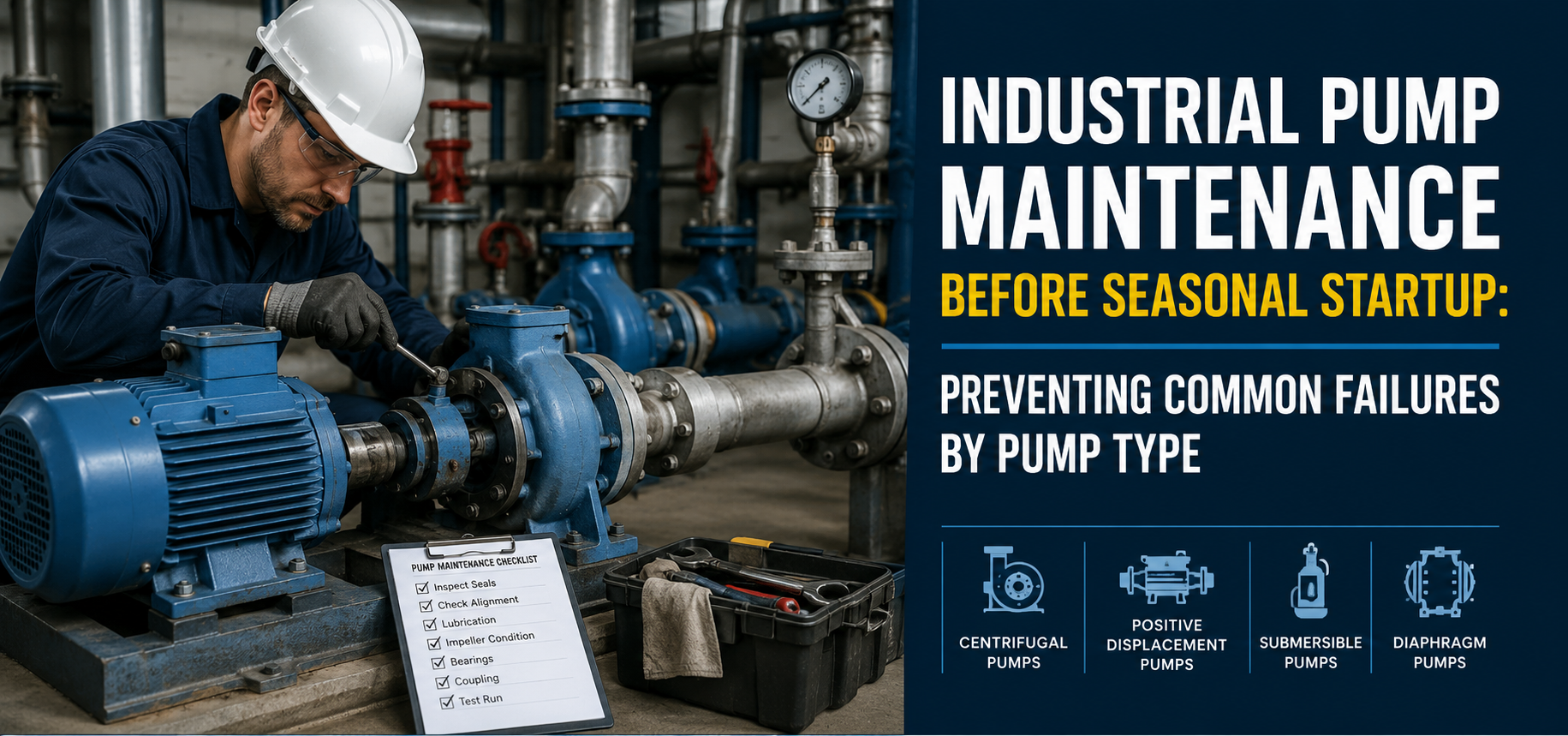
When a facility shuts down for a seasonal transition or planned maintenance, pumps often sit idle for weeks or months. While inactive equipment may appear unaffected, extended downtime can lead to corrosion, seal degradation, lubrication issues, and component wear that often go unnoticed until startup.
Neglecting pre-startup pump inspections can result in reduced efficiency, higher energy costs, unexpected failures, and costly downtime when operations resume. Whether you're preparing a circulator pump for HVAC service or restarting critical process equipment, a thorough inspection is essential.
This guide outlines the key maintenance checks facilities should perform before bringing industrial and commercial pumps back online after an extended shutdown.
Why Seasonal Startup Poses the Greatest Risk to Pump Reliability
Many pump failures occur during the first startup after an extended shutdown. During inactivity, seals can dry out, lubricants may degrade, corrosion can form, and debris can accumulate inside the system. Restarting equipment without proper inspection increases the risk of immediate damage and costly downtime.
Whether you're operating a process pump, cooling water system, or circulator pump, seasonal startup demands careful inspection to prevent avoidable failures.
Common causes of seasonal startup failures include:
- Seal Damage: Dried or hardened mechanical seals can crack, wear prematurely, or leak when the pump is restarted.
- Bearing Wear: Degraded or insufficient lubrication increases friction and accelerates bearing failure under startup loads.
- Misalignment: Equipment movement caused by thermal changes, vibration, or settling can shift pump-to-motor alignment.
- Cavitation: Blocked strainers, incorrect valve positions, or poor suction conditions can trigger cavitation and damage impellers.
- Corrosion and Buildup: Standing water can lead to rust, scaling, or biological growth that restricts flow and damages internal components.
- Motor-Related Issues: Moisture intrusion, insulation deterioration, and lubrication problems can affect motor performance and reliability.
A comprehensive startup inspection helps identify and correct these issues before the pump returns to service. Investing time in preventive maintenance significantly reduces the risk of unexpected downtime, costly repairs, and premature equipment failure.
What Happens if Startup Inspections are Skipped?
Skipping startup inspections may save time initially, but it often leads to costly equipment failures, unplanned downtime, and reduced pump performance. Components that have been idle during a seasonal shutdown can develop issues that are not immediately visible. Restarting pumps without proper inspection increases the risk of damage across the entire system.
Common consequences of skipping startup inspections include:
- Seal Failures: Dry, cracked, or hardened mechanical seals can begin leaking as soon as the pump is restarted, leading to product loss and equipment damage.
- Bearing Damage: Insufficient lubrication, corrosion, or moisture buildup during storage can cause bearings to overheat and fail prematurely.
- Motor Overload: Misalignment, seized rotating parts, or blocked impellers force motors to draw excess current, increasing the risk of overheating and electrical failure.
- Impeller and Internal Component Damage: Debris, corrosion, or scale accumulation can reduce flow, create vibration, and accelerate wear on internal components.
- Cavitation Issues: Blocked suction lines, air pockets, or improper system priming can trigger cavitation, causing erosion, noise, and reduced pump life.
- Reduced Efficiency and Higher Energy Costs: Even minor mechanical issues can force pumps to work harder, increasing energy consumption and operating expenses.
- Unexpected Production Downtime: A pump failure during peak seasonal demand can interrupt operations, delay production schedules, and result in expensive emergency repairs.
A structured startup inspection allows maintenance teams to identify these issues before they become major failures. Verifying lubrication, alignment, seals, electrical connections, fluid quality, and overall pump condition helps ensure reliable operation from day one while minimizing maintenance costs throughout the season.
Vertical Turbine Pumps: Essential Maintenance Before Seasonal Restart
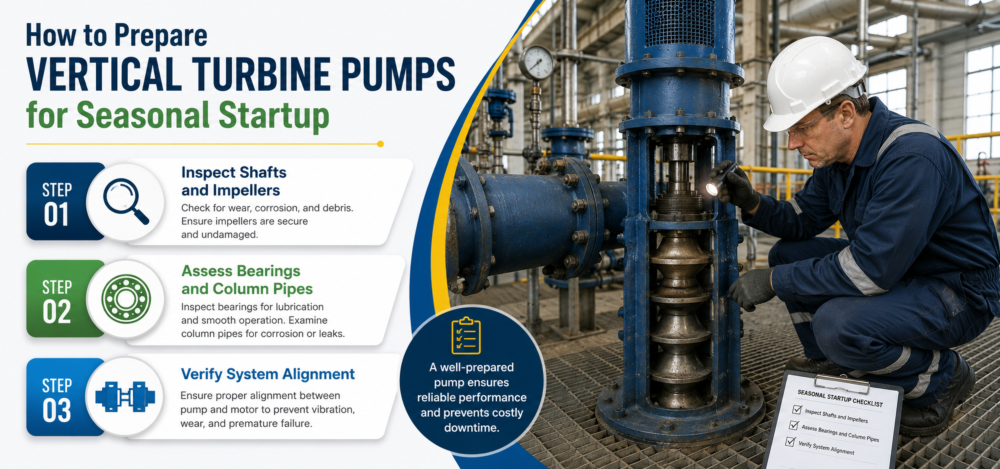
Vertical turbine pumps, including many Goulds Pump models used in municipal, industrial, and irrigation applications, require extra attention after an extended shutdown. Their vertical design, deep-well installation, and multiple bearing assemblies make them more susceptible to startup-related issues than many horizontal pump configurations.
Before returning a vertical turbine pump to service, focus on these critical inspection areas:
Step 1: Inspect the Shaft and Impellers
The shaft and impellers are among the first components that should be evaluated before startup.
- Check the shaft for corrosion, wear, or signs of bending.
- Measure impeller wear ring clearances against manufacturer specifications.
- Inspect impellers and bowl assemblies for pitting, erosion, or corrosion damage.
- Address excessive wear before startup to avoid efficiency losses and vibration issues.
Step 2: Assess Column Pipes and Lineshaft Bearings
Extended downtime can affect both the column assembly and bearing system.
- Inspect column pipes, joints, and flanges for corrosion or deterioration.
- Check water-lubricated lineshaft bearings for sediment buildup or wear.
- Verify that oil-lubricated bearings have clean lubricant at the proper level.
- Replace degraded lubricant before operating the pump.
Step 3: Verify Alignment and System Readiness
Even minor movement during a shutdown can affect pump alignment and performance.
- Confirm proper alignment of the discharge head and shaft assembly.
- Inspect packing and mechanical seals for signs of wear or damage.
- Test Industrial Control Valves, including isolation and check valves, to ensure proper operation.
- Clean and inspect Thompson Filter Strainers to prevent flow restrictions during startup.
Completing these inspections before startup helps reduce the risk of premature wear, vibration, efficiency loss, and unexpected downtime.
HVAC Circulator Pumps: Seasonal Switchover Maintenance
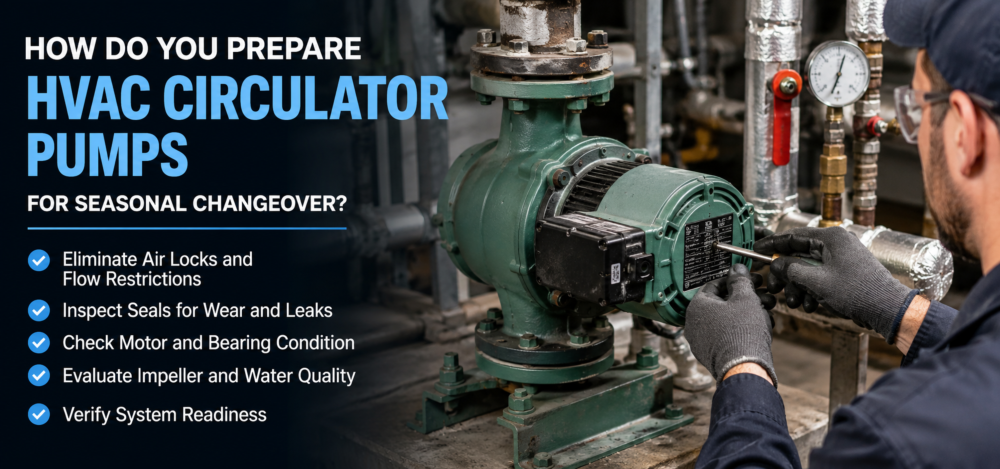
A circulator pump operates within a closed-loop HVAC system, but extended shutdowns can still create reliability issues that surface during seasonal startup. Air infiltration, seal degradation, bearing wear, and water quality problems often develop while the system is idle, making a thorough inspection essential before returning the pump to service.
Air Locks and Flow Restrictions
Air trapped in the system is one of the most common causes of startup problems. During seasonal refilling or pressure adjustments, air can accumulate in piping, high points, and pump casings, restricting flow and reducing system performance.
- Purge trapped air from the system before startup.
- Verify that automatic and manual vents are functioning properly.
- Confirm the pump is delivering flow and not operating in a dry or partially air-bound condition.
Seal Condition and Leakage Risks
Mechanical seals rely on continuous fluid contact for lubrication and cooling. When a pump remains inactive for an extended period, seal faces can dry out, harden, or develop deposits that increase the likelihood of leakage during startup.
- Inspect seals for cracking, hardening, or visible wear.
- Look for mineral deposits or corrosion around seal faces.
- Replace damaged components before placing the pump back into service.
Motor and Bearing Inspection
Although the pump may be idle, motor bearings can still be affected by vibration, moisture, and temperature fluctuations. These conditions can shorten bearing life and create operational issues once the system is restarted.
- Check bearings for unusual noise, roughness, or signs of wear.
- Test motor insulation resistance using a megohmmeter.
- Verify the shaft rotates freely before energizing the motor.
Impeller and Water Quality Evaluation
Poor water quality can accelerate scaling, corrosion, and deposit formation throughout the hydronic system. These issues often become apparent after months of reduced operation or seasonal downtime.
- Inspect impellers for scale, mineral buildup, or debris.
- Remove deposits that may restrict flow or reduce efficiency.
- Verify system water chemistry, including pH, inhibitor levels, and biological control measures.
Confirm System Readiness
Before returning the system to full operation, perform a final inspection of supporting components that could affect pump performance and reliability.
- Clean and inspect Filter Strainers for blockages.
- Verify valves, controls, and safety devices are functioning properly.
- Monitor for leaks, vibration, and abnormal noise during initial startup.
Taking the time to inspect these critical areas before seasonal startup helps improve system efficiency, extend equipment life, and reduce the risk of unexpected HVAC downtime.
Dosing and Metering Pumps: Precision Maintenance for Process Reliability
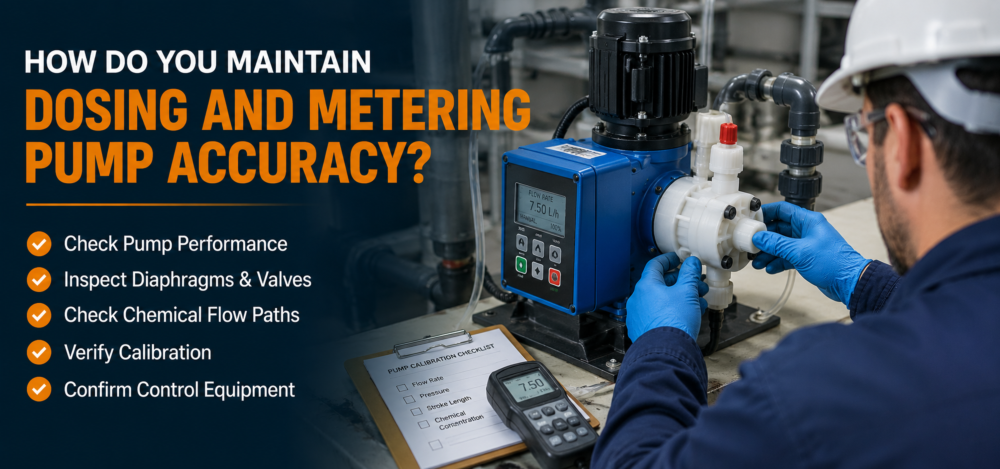
Unlike centrifugal pumps, chemical metering pumps often show few visible signs of deterioration until process performance begins to suffer. Even a small reduction in dosing accuracy can lead to water treatment issues, increased corrosion, product quality concerns, or regulatory compliance problems.
That's why seasonal inspections should focus on both mechanical condition and dosing accuracy before the system returns to operation.
1. Check for Signs of Reduced Performance
Many metering pump issues develop gradually, making routine performance verification critical. Comparing current performance to historical operating data can help identify problems before they affect the process.
Common warning signs include:
- Loss of prime or difficulty maintaining prime.
- Reduced output compared to previous calibration records.
- Increased noise or vibration during operation.
- Inconsistent chemical feed rates or pressure fluctuations.
- Visible chemical residue, staining, or leakage around the pump assembly.
2. Inspect Diaphragms and Check Valves
The diaphragm and injection valves are among the most heavily used components in a metering pump. Wear, fouling, or chemical attack can significantly affect dosing accuracy.
- Inspect diaphragms for wear, deformation, cracking, or discoloration.
- Test injection and suction check valves for proper seating and operation.
- Remove any buildup that could restrict flow or prevent valve sealing.
- Replace worn components according to the manufacturer's maintenance schedule.
3. Evaluate Suction Components and Chemical Pathways
Chemical delivery systems are only as reliable as their suction-side components. Blockages or deterioration in these areas can affect pump performance long before a failure occurs.
- Inspect suction tubing for wear, hardening, or damage.
- Clean suction assemblies and Filter Strainers.
- Verify that chemical supply lines are free of restrictions.
- Check all wetted components for compatibility with the chemicals being used.
4. Perform Calibration and Output Verification
Seasonal startup is an ideal time to confirm that the pump is delivering the expected chemical volume. Even minor deviations can affect treatment effectiveness and process control.
- Perform a complete calibration test.
- Compare actual output against the programmed set point.
- Document results for future maintenance and performance tracking.
- Adjust settings as needed to restore dosing accuracy.
5. Verify Supporting Control Equipment
Many facilities integrate metering pumps with industrial control valves to manage chemical injection and process flow. Problems within the control system can negatively impact pump performance and shorten component life.
- Inspect valve seats for wear or leakage.
- Verify actuator response and control signal accuracy.
- Check for pressure fluctuations that could affect dosing consistency.
- Confirm proper coordination between valves and chemical injection equipment.
A proactive maintenance program helps ensure accurate chemical dosing, protects critical equipment, and minimizes the risk of process disruptions when operations resume after a seasonal shutdown.
Central Pump Steam and Condensate Systems: High-Stakes Seasonal Restart
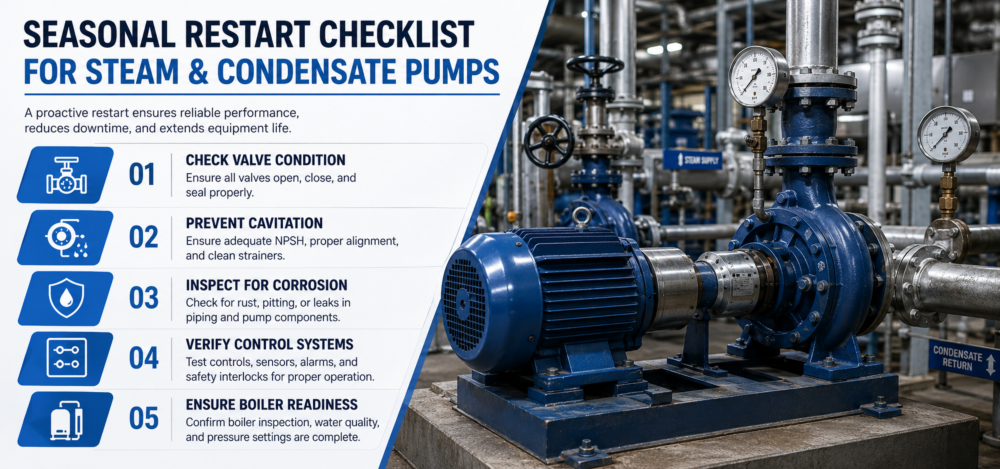
A central pump steam system operates under some of the harshest conditions found in industrial facilities. Elevated temperatures, flash steam, oxygen-rich condensate, and corrosive water chemistry place constant stress on pumps and associated equipment.
After a seasonal shutdown, even minor issues can quickly escalate into leaks, cavitation, or equipment failures if they are not identified before startup.
Condensate return pumps are particularly susceptible to corrosion and thermal shock during restart. A comprehensive inspection helps ensure the system can safely handle operating temperatures and pressures from the moment it returns to service.
Check Valve Integrity
Check valves play a critical role in maintaining proper condensate flow and preventing reverse flow conditions. Because they operate in a high-temperature environment, valve seats and discs can experience significant wear during normal operation and corrosion during idle periods.
Key inspection items include:
- Examining valve seats and discs for erosion or corrosion.
- Verifying smooth operation and positive seating.
- Checking for signs of leakage or flow restrictions.
Suction Conditions and Cavitation Prevention
Condensate often reaches the pump at temperatures close to its boiling point, making suction conditions especially important. Inadequate Net Positive Suction Head (NPSH) can result in flash cavitation, causing rapid damage to impellers and internal components.
Before startup:
- Verify adequate NPSH is available.
- Inspect suction piping for restrictions or obstructions.
- Confirm valves are in the proper operating position.
- Review system conditions that could contribute to cavitation.
Internal Corrosion Assessment
During extended shutdowns, oxygen exposure and stagnant condensate can accelerate corrosion inside pump casings and piping. Left unchecked, corrosion can reduce efficiency, damage sealing surfaces, and shorten equipment life.
Inspection activities should include:
- Opening accessible pump casings for visual inspection.
- Looking for pitting, rust, scaling, or deposit buildup.
- Examining impellers, wear rings, and seal surfaces.
- Removing debris before startup.
Instrumentation and Control System Verification
Accurate controls are essential for maintaining stable steam and condensate system performance. Faulty instrumentation can create pressure fluctuations and operating conditions that increase stress on pumps.
As part of the startup process:
- Calibrate and verify Fisher Controls and related instrumentation.
- Confirm proper actuator operation.
- Validate pressure and temperature setpoints.
- Test control responses before introducing full system load.
Connection to Boiler Reliability
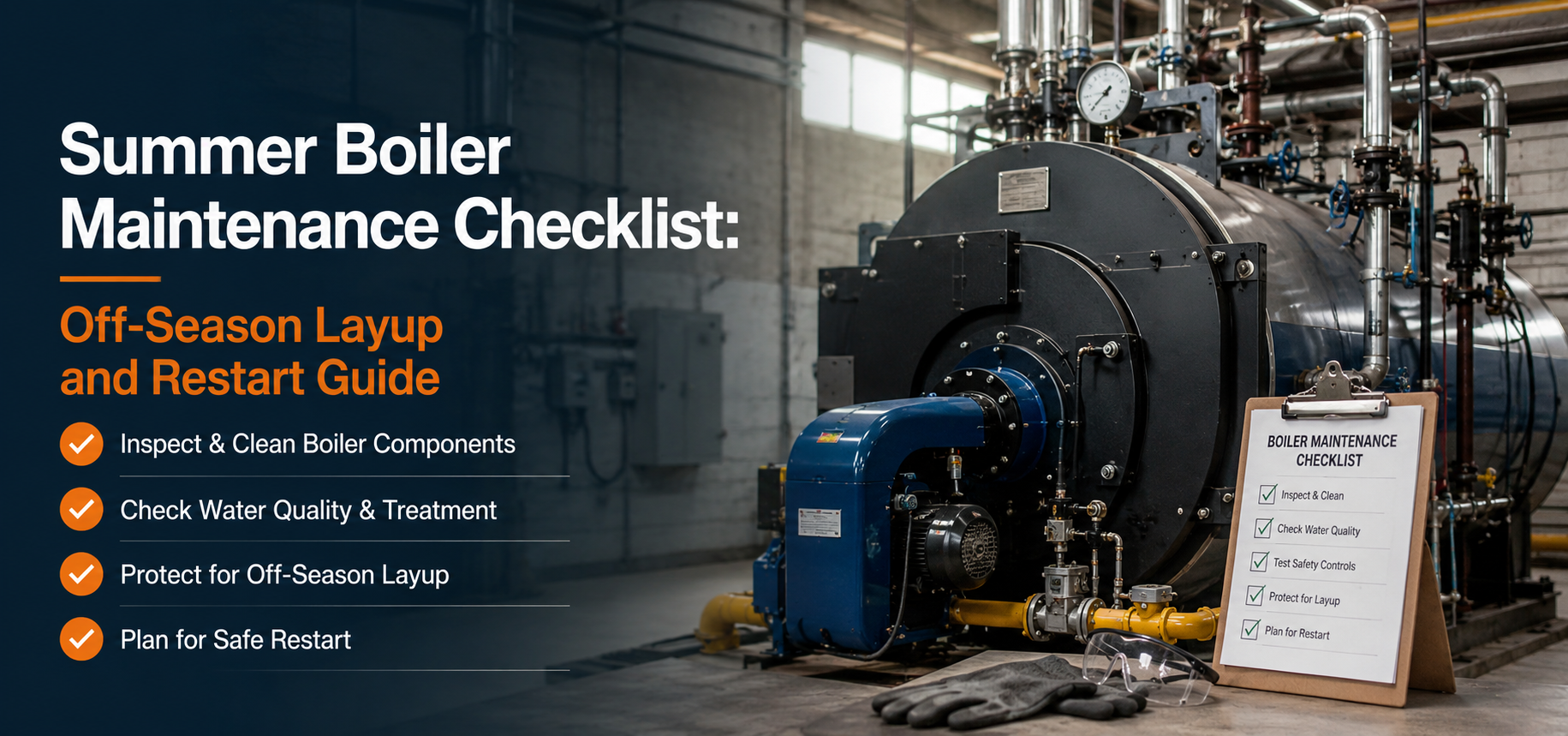
Steam and condensate pumps are closely tied to overall boiler performance. For that reason, pump inspections should be incorporated into any facility-wide Boiler Maintenance Checklist rather than treated as a separate maintenance task.
Evaluating condensate return equipment alongside boiler startup activities helps improve water quality management, protect feedwater systems, and reduce the risk of unexpected downtime throughout the heating season.
A proactive inspection program ensures steam and condensate pumps are prepared for demanding operating conditions while supporting reliable and efficient system performance.
Pump Type Quick Reference: Seasonal Startup Inspection Guide
Different pump systems fail in different ways, especially after extended shutdowns. A targeted inspection approach helps facilities prevent avoidable downtime by focusing on the most common failure modes for each pump type.
The table below provides a quick reference for seasonal startup planning across major industrial and HVAC pump systems.
| Pump Type | Common Failure Points | Seasonal Inspection Priorities | Recommended Service Interval |
|---|---|---|---|
| Vertical Turbine Pump | Bearing wear, shaft misalignment, and column pipe corrosion | Shaft alignment, lubrication condition, impeller clearance, and column inspection | Annual pre-startup and periodic monitoring |
| HVAC Circulator Pump | Seal leakage, air lock, motor bearing failure, and impeller scaling | Seal integrity, motor insulation, air venting/purging, and flow balancing | Seasonal (before heating/cooling changeover) |
| Dosing/Metering Pump | Diaphragm rupture, injection valve blockage, and chemical buildup | Diaphragm condition, tubing integrity, valve performance, and output calibration | Monthly calibration and annual servicing |
| Process/Centrifugal Pump | Cavitation, seal failure, impeller erosion, and coupling misalignment | Seal condition, impeller wear, alignment check, and suction line evaluation | Annual or more frequent in severe service |
| Steam Condensate Pump | Corrosion, flash steam damage, check valve failure, and cavitation | Check valve integrity, NPSH verification, corrosion inspection, and strainer condition | Semi-annual or pre-season restart |
A structured approach like this helps maintenance teams quickly identify what matters most for each system, rather than applying a one-size-fits-all inspection routine. By aligning inspection priorities with actual failure risks, facilities can significantly improve reliability, reduce emergency repairs, and ensure smoother seasonal startups across all pump categories.
How Often Should Industrial Pumps Be Serviced?
Pump maintenance isn't a one-time task; it works best as a layered schedule that combines routine monitoring with deeper inspections. The goal is simple: catch early warning signs before they turn into shutdowns, especially in critical industrial systems where uptime directly impacts production and energy costs.
Instead of treating all pumps the same, maintenance is typically structured around how frequently risks develop in the system.
Monthly: Early Warning Checks
These quick inspections focus on spotting performance drift before it becomes visible damage. They're especially important in systems running continuously or handling chemicals, water treatment, or HVAC loads.
- Look for leaks, vibration, abnormal noise, or temperature rise
- Check basic operating performance trends
- Verify calibration on chemical metering pumps
- Clean or inspect strainers in fouling-prone systems
Quarterly: Mechanical Stability Checks
At this stage, the focus shifts to mechanical health and system balance. These checks help prevent gradual wear from turning into failure.
- Lubricate bearings where applicable
- Inspect alignment in high-speed or critical pumps
- Record vibration readings for trend analysis
- Review operating conditions for early stress indicators
Semi-Annual: Deeper Component Review
Semi-annual servicing targets components that degrade silently but can cause major failures if ignored.
- Inspect mechanical seals for early leakage or wear
- Test motor insulation resistance
- Clean and inspect Filter Strainers, check valves, and Industrial Control Valves
- Evaluate system efficiency and flow stability
Annual: Full Mechanical Overhaul
This is the most comprehensive service cycle, focusing on restoring pump condition and resetting reliability for the next operating cycle.
- Inspect and replace worn components (impellers, wear rings, bearings, and seals)
- Perform shaft alignment correction
- Service lubrication systems completely
- Calibrate and verify instrumentation and controls
Before Seasonal Startup: Critical Readiness Check
Even if annual servicing has been completed, seasonal startup requires its own focused inspection, especially after long idle periods.
This includes verifying lubrication conditions, ensuring free rotation, checking seals and bearings, cleaning strainers, confirming alignment, and validating control system readiness before restart.
A structured approach like this avoids repetitive failures and ensures pumps don't just run but run reliably across seasons and operating cycles.
Control Specialties: Engineering Confidence in Every Pump Startup
Pump failures across industrial systems are often traced back to overlooked risks during shutdowns and seasonal restarts. Successful seasonal startups depend on identifying hidden wear, restoring proper lubrication, verifying alignment, and confirming system readiness before pumps return to full load.
From vertical turbine and circulator pumps to dosing and steam condensate systems, issues like seal wear, cavitation, corrosion, and misalignment typically develop silently and only surface when equipment is restarted under load. This makes structured inspection and maintenance essential for reliable performance.
Control Specialties, one of the most trusted industrial parts distributors in the USA, has decades of hands-on experience with complex pumping systems and associated instrumentation. We help facilities prevent these failures before they happen. The team understands how pump performance is directly influenced by system components such as Industrial Control Valves, Filter Strainers, and precision solutions like Fisher Controls, enabling more reliable startup conditions and improved operational stability.
For expert guidance on seasonal startup planning or pump system optimization, connect with our experts to ensure your equipment is ready for dependable performance.
Frequently Asked Questions (FAQs)
How do I know if my pump is at risk even when it is still running normally?
Many pump issues develop gradually without obvious symptoms. Subtle changes like rising vibration, reduced discharge pressure, or inconsistent flow can indicate early-stage wear in seals, bearings, or internal components. Regular condition monitoring helps detect these risks before failure occurs.
What is the most common mistake facilities make during seasonal pump restarts?
The most common mistake is restarting equipment without verifying internal conditions after shutdown. Issues like dry seals, degraded lubrication, or blocked strainers are often overlooked, leading to immediate startup failures and avoidable downtime.
Can poor system controls affect pump performance even if the pump itself is in good condition?
Yes. Inaccurate or unstable control systems can create pressure fluctuations, improper flow conditions, and excessive load on pumps. Components such as Industrial Control Valves and instrumentation must function correctly to maintain stable operation.
How does water quality impact pump reliability after shutdown?
Poor water chemistry can accelerate corrosion, scaling, and biological growth during idle periods. When the system restarts, these deposits can restrict flow, damage impellers, and reduce overall pump efficiency.
Should pumps be inspected even if they were recently serviced?
Yes. Even recently serviced pumps can develop issues during shutdown, especially if they remain idle for extended periods. A pre-startup inspection ensures that seals, lubrication, alignment, and system conditions are still suitable for safe operation.
Why do pumps fail after seasonal shutdowns?
Pumps can fail after seasonal shutdowns due to seal deterioration, bearing corrosion, lubricant degradation, or debris buildup that occurs during inactivity. Performing a thorough inspection, lubrication, and startup check helps prevent unexpected failures and extends equipment life.
Why should water quality be checked before restarting HVAC pumps?
Water quality should be checked before restarting HVAC pumps because contaminants, corrosion, scale, or improper chemical balance can damage pump components, reduce efficiency, and restrict flow. Testing and treating the water helps protect the system and ensures reliable operation.