Table of contents
- Understanding the Basics of System Pressure Control
- What is a Back Pressure Regulator?
- What is a Relief Valve?
- Back Pressure Regulator vs. Relief Valve: The Major Differences
- Back Pressure Regulator vs. Relief Valve: A Quick Comparison Table
- When Should You Use a Back Pressure Regulator?
- When Should You Use a Relief Valve?
- How to Choose the Right Device for Your Application
- Why Proper Valve Selection Matters for Long-Term System Performance
- Back Pressure Regulators and Relief Valves: Different Roles, One Complete Pressure Strategy
- Frequently Asked Questions (FAQs)
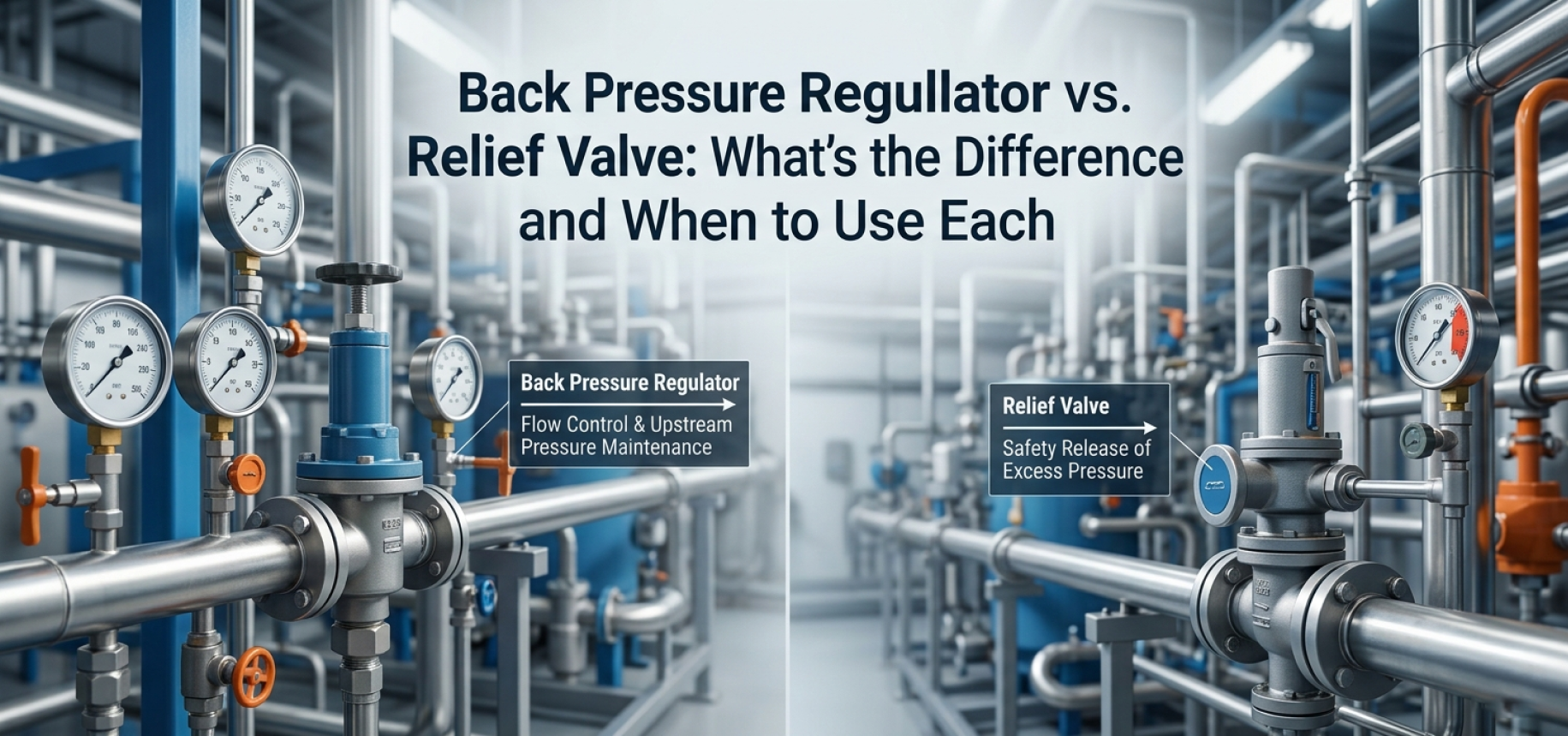
Improper pressure control can lead to equipment damage, process instability, safety risks, compliance violations, and costly downtime. Understanding the difference between back pressure regulators and relief valves is essential for selecting the right protection strategy.
However, they serve fundamentally different purposes. Selecting the wrong device can result in equipment damage, process instability, compliance issues, costly downtime, or serious safety hazards.
Understanding how each device operates and where it should be used is essential for reliable system performance. This blog explains the key differences, applications, and selection considerations to help you choose the right solution with confidence.
Understanding the Basics of System Pressure Control
Pressure variations occur naturally as flow rates, temperatures, and process demands change throughout a system. Without the proper control strategy, these fluctuations can reduce efficiency, accelerate equipment wear, and increase the risk of unplanned downtime.
What is Pressure Control?
Pressure control is the process of maintaining pressure within a safe and specified operating range throughout a pipeline, vessel, or process system. Effective pressure management is essential for protecting equipment, ensuring process stability, and maintaining safe operating conditions.
Most industrial systems involve two critical pressure zones:
- Upstream Pressure (inlet): Pressure generated by the source, such as a pump, compressor, boiler, or pressurized supply header.
- Downstream Pressure (outlet): Pressure experienced by the receiving equipment, instruments, or process application.
When pressure moves beyond design limits, operational and safety risks increase significantly. Excessive pressure can damage equipment, rupture vessels, and create hazardous conditions, while insufficient pressure can reduce flow, impair process performance, or cause equipment failure. Maintaining stable pressure is therefore a fundamental requirement for reliable system operation.
Where Pressure Problems Typically Occur
Pressure-related issues can develop across a wide range of industrial applications, including:
- Pumps and Compressors: Blocked discharge lines, deadheading, or surge conditions can create damaging pressure spikes.
- Boilers and Steam Systems: Pressure rises when steam generation exceeds process demand.
- Chemical Processing Operations: Rapid reactions, thermal expansion, or sudden valve closures can generate unexpected pressure surges.
- Filtration and Membrane Systems: Pressure fluctuations can reduce efficiency and shorten membrane life.
- Storage Tanks and Pressure Vessels: Overfilling or thermal expansion can cause dangerous overpressure conditions if not properly controlled.
The appropriate solution depends on the objective. If the goal is to maintain and regulate operating pressure, a control device is required. If the goal is to protect equipment from unsafe overpressure conditions, a safety device is necessary. Understanding this distinction is the first step in selecting the right pressure management solution.
What is a Back Pressure Regulator?
A back pressure regulator is designed to maintain a constant upstream pressure by automatically adjusting the flow through the valve.
Unlike emergency pressure protection devices, it operates continuously as part of normal process control to keep systems stable, efficient, and within their intended operating range.
Definition and Purpose
A back pressure regulator is a self-actuated valve that continuously monitors and controls pressure on its inlet (upstream) side. Its primary function is to maintain a predetermined upstream pressure setpoint by modulating flow to the outlet (downstream) side.
Because it operates continuously, it helps ensure consistent process conditions despite fluctuations in flow demand or operating pressure.
How a Back Pressure Regulator Works
- Senses Inlet Pressure: A diaphragm or piston is exposed directly to upstream pressure.
- Compares Pressure to the Setpoint: A preloaded spring provides the force corresponding to the desired pressure setting.
- Modulates Flow Proportionally: When upstream pressure rises above the setpoint, the valve gradually opens to relieve excess pressure and maintain control.
- Restores System Balance: As pressure returns to the target level, the valve adjusts toward a throttled position to maintain the desired setpoint.
Key Components
- Spring: Establishes the pressure setpoint and determines when the valve begins to open.
- Diaphragm or Piston: Detects upstream pressure and converts it into mechanical movement.
- Valve Plug and Seat: Regulate flow by adjusting the valve opening.
- Sensing Mechanism: Transmits process pressure to the actuator assembly.
Main Benefits
- Precise and continuous upstream pressure control
- Improved process stability under changing operating conditions
- Reduced stress on pumps, compressors, and upstream equipment
- Protection against deadheading in positive displacement pump systems
- Self-actuated operation with no external power requirement
- Lower maintenance requirements compared to complex control systems
The Fisher MR95/MR98 is a widely used back pressure regulator series for industrial steam, gas, and liquid applications, delivering accurate upstream pressure control in a compact, self-contained design.
What is a Relief Valve?
A relief valve is a critical safety device designed to prevent pressure from exceeding the maximum allowable limit of a system. Unlike a back pressure regulator, it doesn't manage routine operating pressure; it remains inactive until an unsafe overpressure condition occurs.
Definition and Purpose
A relief valve is a safety device designed to protect pressure vessels, boilers, pipelines, and other process equipment from dangerous overpressure conditions. It acts as the final line of defense when system pressure exceeds safe operating limits.
Required by ASME, API, and OSHA standards in many applications, the Kunkle Relief Valves series is widely trusted for reliable overpressure protection in steam, gas, and liquid systems.
How a Relief Valve Works
- Remains Closed During Normal Operation: A calibrated spring keeps the disc tightly seated, preventing flow through the valve.
- Responds to Overpressure Conditions: When system pressure reaches the set pressure or Maximum Allowable Working Pressure (MAWP), the force exerted by the fluid overcomes the spring force.
- Rapidly Relieves Excess Pressure: The valve opens and discharges fluid to the atmosphere, a vent system, or another designated safe location.
- Automatically Reseats: Once pressure falls below the set pressure and blowdown range, the spring closes the valve and restores the pressure boundary.
In steam applications, this action is commonly known as "pop action." Rather than gradually throttling flow, the valve opens quickly and fully to achieve maximum relieving capacity and rapidly reduce pressure.
Key Components
- Calibrated Spring: Set to the designated relief pressure and holds the valve closed during normal operation.
- Disc: Forms the primary seal against the seat.
- Seat: Precision-machined sealing surface that ensures reliable reseating after operation.
- Huddling Chamber and Pressure Chamber: Enhance pop action and control blowdown characteristics, particularly in steam service.
Main Benefits
- Immediate protection against dangerous overpressure conditions
- Reduced risk of equipment damage and catastrophic vessel failure
- Enhanced personnel and facility safety
- Compliance with ASME, API, and OSHA requirements
- Reliable, passive protection that operates without external power or controls
For testing requirements, inspection frequencies, and compliance guidance, refer to Safety Valve Testing Requirements.
Understanding how relief valves function is essential before comparing them with back pressure regulators. The next sections examine the key differences in purpose, operation, pressure control strategy, installation, and application to help determine when each device should be used.
Back Pressure Regulator vs. Relief Valve: The Major Differences
While both devices respond to pressure changes, they serve fundamentally different functions within a process system. A back pressure regulator is designed to maintain a stable operating pressure, whereas a relief valve protects equipment from dangerous overpressure conditions.
Understanding these differences is critical for proper equipment selection, process reliability, and regulatory compliance.
1. Purpose: Process Control vs. Emergency Protection
Back Pressure Regulator
A back pressure regulator maintains a consistent upstream pressure during normal operation. It continuously adjusts flow to compensate for changing process conditions, helping pumps, instruments, and other upstream equipment operate efficiently and reliably.
Relief Valve
A relief valve is a safety device designed to protect equipment from dangerous overpressure conditions. It remains closed during normal operation and opens only when pressure exceeds a predetermined safety limit, preventing equipment damage and safety risks.
The Verdict
A back pressure regulator controls operating pressure to support process performance, while a relief valve provides emergency overpressure protection. Together, they ensure both operational reliability and system safety.
2. Operating Philosophy: Continuous Modulation vs. Event-Triggered Action
Back Pressure Regulator
A back pressure regulator continuously adjusts its position to maintain a stable upstream pressure as process conditions change. This proportional response helps absorb flow fluctuations and maintain consistent system performance.
Key characteristics:
- Continuous pressure control
- Proportional valve movement
- Smooth response to changing demand
Relief Valve
A relief valve remains closed during normal operation and activates only when pressure reaches a predetermined safety limit. It opens rapidly to relieve excess pressure and protect the system.
Key characteristics:
- Closed during normal operation
- Activates during overpressure events
- Rapid relief action
The Verdict
A back pressure regulator continuously manages operating pressure, while a relief valve responds only to unsafe pressure conditions. One provides ongoing process control; the other delivers emergency overpressure protection.
3. Pressure Setpoints: Operating Range vs. Safety Threshold
Back Pressure Regulator
A back pressure regulator is set at or near the system's normal operating pressure to maintain stable process conditions.
For example, in a system operating at 50 PSI, the regulator may be set at that target pressure. The Fisher MR95/MR98 offers adjustable settings to match a wide range of process requirements.
Relief Valve
A relief valve is set at the Maximum Allowable Working Pressure (MAWP) of the protected equipment. This safety threshold is intentionally higher than normal operating pressure and should only be reached during abnormal conditions.
The Verdict
Back pressure regulators control operating pressure, while relief valves protect the system when pressure exceeds safe limits. Because they serve different pressure ranges, their setpoints should never be treated as interchangeable.
4. Accuracy and Responsiveness
Back Pressure Regulator
A well-sized back pressure regulator is designed for precise pressure control. The Fisher MR95/MR98 maintains upstream pressure close to the setpoint, even when flow demand changes.
This level of accuracy is critical in applications such as filtration, chemical injection, and process systems where pressure fluctuations can affect performance and product quality.
Relief Valve
A relief valve is designed for dependable safety performance rather than precise pressure control. The Kunkle Relief Valve opens at the designated set pressure and quickly relieves excess pressure to protect equipment and personnel during overpressure events.
The Verdict
A back pressure regulator delivers the accuracy needed for stable process operation, while a relief valve provides the reliability required for overpressure protection. Each is optimized for a specific function and should be selected accordingly.
5. Installation Location in the System
Back Pressure Regulator
A back pressure regulator is installed directly in the process flow path between the pressure source and downstream equipment. Because it continuously regulates pressure, all process fluid flows through the valve during normal operation.
Relief Valve
A relief valve is typically installed on a branch connection near the vessel, boiler, or pipeline being protected. It remains outside the normal flow path and carries flow only during an overpressure event.
The Verdict
Installation location reflects each device's role. A back pressure regulator is placed in line for continuous pressure control, while a relief valve remains on standby until protection is required. Both should be accessible for routine inspection and maintenance.
6. Flow Characteristics: Modulating vs. Relief Action
Back Pressure Regulator
A back pressure regulator controls flow through gradual, proportional valve movement. It opens only as much as needed to maintain the desired pressure setpoint, allowing fluid to pass at a controlled rate.
This modulating action helps minimize pressure fluctuations, system shock, and unnecessary equipment wear.
Relief Valve
A relief valve is designed for rapid pressure relief rather than flow control. When the set pressure is reached, the valve opens quickly to discharge excess fluid and reduce pressure.
In steam and vapor applications, the valve often "pops" fully open to achieve maximum relieving capacity.
The Verdict
A back pressure regulator provides controlled, modulating flow for stable process operation, while a relief valve delivers rapid, high-capacity discharge during overpressure events. Each flow characteristic is specifically engineered for its intended function and should not be used interchangeably.
7. Impact on Process Stability and System Safety
Back Pressure Regulator
A properly sized back pressure regulator helps maintain stable operating conditions throughout the system.
Consistent pressure reduces stress on pumps, improves instrument accuracy, and supports reliable equipment performance. Over time, this can reduce maintenance requirements and extend equipment life.
Relief Valve
A relief valve enhances system safety by protecting equipment and personnel from dangerous overpressure conditions.
Because it remains inactive during normal operation, it doesn't affect process stability but provides critical protection when needed. It's also essential for compliance with industry safety standards.
The Verdict
A back pressure regulator improves day-to-day process performance and equipment reliability, while a relief valve provides the safety protection required during abnormal pressure events. Together, they support both operational efficiency and long-term system safety.
Back Pressure Regulator vs. Relief Valve: A Quick Comparison Table
The table below summarizes the key differences between a back pressure regulator and a relief valve, providing a quick reference for selecting the right device for your application.
| Feature | Back Pressure Regulator | Relief Valve |
|---|---|---|
| Primary Function | Maintains stable upstream pressure during normal operation | Protects equipment from dangerous overpressure conditions |
| Operating Mode | Continuously modulates to maintain the setpoint | Remains closed until the set pressure is reached |
| Pressure Setpoint | Set at or near the desired operating pressure | Set at the Maximum Allowable Working Pressure (MAWP) |
| Activation Trigger | Responds to routine pressure fluctuations | Activates only during overpressure events |
| Control Accuracy | Designed for precise pressure regulation | Designed for reliable safety activation |
| Flow Characteristics | Gradual and proportional flow adjustment | Rapid pressure relief at rated capacity |
| Normal Operating State | Continuously regulating pressure | Closed and inactive |
| Installation Location | In line with the process piping | Branch connection on a vessel, boiler, or pipeline |
| Impact on System Performance | Improves process stability and equipment life | Enhances system safety and regulatory compliance |
| Example Products | Fisher MR95/MR98 and Fisher Type 627 | Kunkle Relief Valve Series 6000 and 900 |
When Should You Use a Back Pressure Regulator?
A back pressure regulator is the ideal solution when maintaining a consistent upstream pressure is critical for process performance, equipment protection, and operational efficiency. The following applications commonly benefit from this type of pressure control.
Scenario 1: Protecting Positive Displacement Pumps
Positive displacement pumps can generate excessive pressure when downstream flow is restricted or blocked. Maintaining a controlled discharge pressure helps protect pumps, seals, and piping from deadhead conditions and premature wear.
Scenario 2: Chemical Dosing and Injection Systems
Accurate dosing depends on stable injection pressure and flow rates. Consistent pressure improves dosing accuracy, helping maintain product quality, process efficiency, and regulatory compliance.
Scenario 3: Membrane Filtration and Separation Systems
Membrane systems perform best within a defined pressure range. Maintaining steady feed pressure helps maximize filtration efficiency while reducing the risk of membrane damage and premature replacement.
Scenario 4: Steam Distribution Headers
Fluctuating steam demand can cause pressure variations across the system. The Fisher MR95/MR98 helps maintain stable header pressure, ensuring reliable steam delivery to downstream processes.
For related steam system maintenance insights, see our Steam Trap Troubleshooting Guide.
Scenario 5: Process Manufacturing and Recirculation Systems
Many food, pharmaceutical, and chemical processes rely on consistent operating pressure to maintain product quality. Stable pressure conditions help improve process repeatability and overall system performance.
Warning Signs You Need a Back Pressure Regulator
- Frequent pressure fluctuations in the process line
- Inconsistent product quality caused by pressure variations
- Excessive pump wear or recurring maintenance issues
- Unstable pressure readings from gauges and instrumentation
- Process equipment operating outside its intended pressure range
When Should You Use a Relief Valve?
A relief valve is required whenever equipment must be protected from dangerous overpressure conditions. In many applications, it is not only a safety requirement but also a regulatory obligation.
Scenario 1: Boiler and Steam Generator Protection
Steam boilers operate under high-pressure conditions and must be protected against unexpected pressure buildup. A properly sized Kunkle Relief Valve helps prevent overpressure caused by excess steam generation, equipment malfunction, or blocked outlets.
Scenario 2: Compressed Air and Gas Systems
Compressed air receivers, gas storage vessels, and compressor discharge lines can experience rapid pressure increases. Pressure relief protection helps prevent equipment damage and ensures safe operation during upset conditions.
Scenario 3: Hydraulic Systems
Hydraulic systems are vulnerable to sudden pressure spikes caused by load changes, valve closures, or actuator movement. Pressure relief devices help protect pumps, cylinders, hoses, and other system components from excessive pressure.
Scenario 4: Storage Tanks and Pressure Vessels
Thermal expansion, overfilling, and process upsets can increase vessel pressure beyond safe limits. Properly sized relief protection helps safeguard equipment integrity and reduce the risk of vessel failure.
Scenario 5: Process Safety and Regulatory Compliance
Many industrial facilities must comply with ASME, API, and OSHA requirements for overpressure protection. An ASME-certified relief valve provides the protection and compliance needed for pressure vessels, boilers, and critical process systems.
Warning Signs You Need a Relief Valve
- Pressure vessels, boilers, or heat exchangers are present in the system
- Upcoming OSHA, API, or ASME compliance inspections
- Existing protection devices are outdated, damaged, or uncertified
- The system handles compressed gases, steam, or other pressurized fluids
- Operating pressures approach equipment design limits
How to Choose the Right Device for Your Application
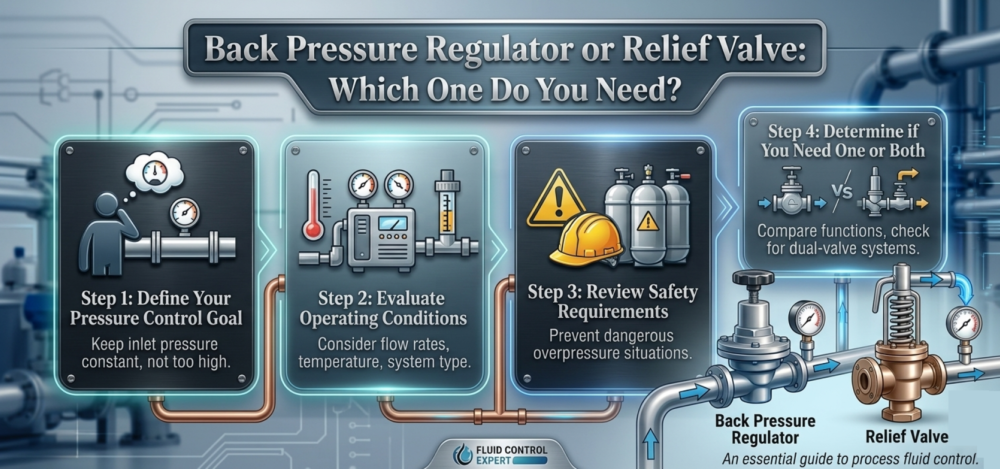
Selecting the right pressure control device starts with understanding what you're trying to achieve. In many industrial systems, the answer isn't choosing one or the other; it's determining whether you need pressure control, overpressure protection, or both.
Step 1: Define Your Objective
Start by identifying the primary purpose of the device:
Maintain Stable Operating Pressure: Use a Back Pressure Regulator (e.g., Fisher MR95/MR98, Fisher Type 627)
Protect Against Dangerous Overpressure: Use a Relief Valve (e.g., Kunkle Relief Valve series)
Need Both Process Control and Safety Protection: Install both devices
Step 2: Evaluate Your Operating Conditions
Before selecting a device, consider the following:
- What is the normal operating pressure?
- How much does the system demand or flow change?
- What is the Maximum Allowable Working Pressure (MAWP)?
- What fluid is being handled and at what temperature?
- Is the application critical to product quality or equipment protection?
Step 3: Review Safety and Compliance Requirements
Pressure vessels, boilers, and many pressurized systems require ASME-certified overpressure protection. While Back Pressure Regulators, Fisher Regulators, and Industrial Control Valves support process controls, they don't replace a code-certified relief valve where regulations require one.
Step 4: Determine Whether You Need One Device or Both
| Application | Back Pressure Regulator | Relief Valve |
|---|---|---|
| Maintain stable operating pressure | ✔ Recommended | May also be required by code |
| Positive displacement pump protection | ✔ Recommended | Not typically the primary solution |
| Chemical dosing and injection systems | ✔ Recommended | Not required for pressure control |
| Steam header pressure stabilization | ✔ Recommended | Required on the boiler or vessel |
| Boiler, vessel, or pressure chamber protection | ✘ Not a safety device | ✔ Required |
| Compressed air and gas system safety | ✘ Not intended for this purpose | ✔ Recommended |
| ASME/OSHA compliance requirements | ✘ Cannot satisfy code requirements alone | ✔ Required |
| Process control and safety protection | ✔ Install | ✔ Install |
The simplest rule is this:
- If you need to control pressure during normal operation, choose a Back Pressure Regulator.
- If you need to protect equipment from unsafe pressure conditions, choose a Relief Valve.
In many industrial applications, both devices work together to deliver reliable performance, equipment protection, and regulatory compliance.
Why Proper Valve Selection Matters for Long-Term System Performance
Selecting the right pressure and control devices helps improve reliability, efficiency, and safety throughout the system. Properly matched components can deliver measurable long-term benefits, including:
- Lower Maintenance Costs: Equipment operating within its intended pressure range experiences less wear, reducing repair frequency and maintenance expenses.
- Extended Equipment Life: Stable pressure conditions help protect pumps, compressors, heat exchangers, and other critical assets from premature failure.
- Improved Process Efficiency: Consistent operating conditions support better product quality, higher yields, and more predictable process outcomes.
- Reduced Energy Consumption: Systems operating at stable pressure setpoints require less energy than those experiencing frequent fluctuations.
- Enhanced Process Control: Solutions such as the Fisher 1301F2, temperature regulators, and other specialized control devices help maintain consistent operating conditions in demanding applications.
- Greater Workplace Safety: Properly selected and maintained relief valves help protect personnel and equipment from dangerous overpressure events.
- Less Unplanned Downtime: Preventing pressure-related failures minimizes production disruptions and improves overall system reliability.
Back Pressure Regulators and Relief Valves: Different Roles, One Complete Pressure Strategy
Although back pressure regulators and relief valves both respond to pressure changes, they serve fundamentally different purposes. A back pressure regulator maintains stable operating pressure during normal conditions, while a relief valve protects equipment and personnel when pressure exceeds safe limits.
Understanding the differences in their purpose, operation, setpoints, flow characteristics, and installation requirements is essential for selecting the right device and avoiding costly system issues.
Control Specialties, a premier industrial equipment supplier, helps customers identify the right pressure management solutions for their applications. Whether you need assistance selecting regulators, relief valves, conbraco valves, or sourcing products through a trusted Velan Valves Distributor, get in touch with our specialists for technical expertise and product support needed to keep your systems operating safely, efficiently, and reliably.
Frequently Asked Questions (FAQs)
How do I size a back pressure regulator for my application?
Proper sizing depends on factors such as flow rate, inlet pressure, fluid type, temperature, and the desired pressure setpoint. An incorrectly sized regulator can lead to unstable pressure control, excessive wear, and reduced system efficiency. Working with a valve specialist helps ensure optimal performance and reliability.
How often should relief valves be inspected or replaced?
Inspection and testing intervals differ based on service conditions, industry requirements, and regulatory standards. Factors such as corrosion, cycling frequency, and process media can affect valve performance. Regular inspections help verify that the valve will operate correctly when overpressure protection is needed.
Can one relief valve protect multiple pieces of equipment?
In some systems, a single relief valve may protect multiple components if it's properly sized and installed. However, pressure drop, relieving capacity, piping configuration, and applicable code requirements must be carefully evaluated to determine whether shared protection is appropriate.
What are the signs that a pressure control device is undersized or improperly selected?
Common indicators include frequent pressure fluctuations, valve chatter, excessive noise, recurring maintenance issues, poor process stability, and unexpected valve cycling. These symptoms often suggest that the device is not properly matched to the operating conditions.
Should I repair or replace an aging regulator or relief valve?
The decision depends on the valve's condition, service history, compliance requirements, and the availability of replacement parts. In many cases, upgrading to a newer solution can improve reliability, efficiency, and long-term operating costs while ensuring continued compliance with current standards.
Can a back pressure regulator improve pump life?
Yes. A properly sized back pressure regulator can help extend pump life by maintaining consistent system pressure, minimizing pressure fluctuations, reducing the risk of cavitation, and preventing excessive wear on seals, bearings, and other internal components. This leads to more reliable pump performance, lower maintenance costs, and a longer service life.