Table of contents
- What is a Safety Relief Valve and Why Does Testing Matter?
- Safety Relief Valve Compliance: Understanding ASME and NBIC Standards
- How Often Should Safety Relief Valves Be Tested?
- What are the Different Types of Safety Relief Valve Tests?
- How to Choose the Right Safety Relief Valve Testing Method
- Safety Relief Valve Testing vs. Certification: What's the Difference?
- Common Causes of Safety Relief Valve Inspection Failures
- How to Inspect a Safety Relief Valve: Step-by-Step Procedure
- Safety Relief Valve Documentation and Recordkeeping Requirements
- How to Choose the Right Safety Relief Valve for Your Application
- Safety Relief Valve Maintenance and Compliance Best Practices
- Get Expert Support for Safety Relief Valve Selection, Testing, and Compliance
- Frequently Asked Questions (FAQs)
When pressure systems exceed safe operating limits, safety relief valves provide the last line of defense against equipment damage, regulatory violations, and potentially catastrophic failures. When system pressures exceed safe limits, these devices must respond immediately and accurately to protect personnel, equipment, and operations.
Because of their critical role, regular testing and inspection of safety relief valves are required under ASME, NBIC, and other applicable codes. However, many facilities are uncertain about testing intervals, certification requirements, and the differences between field and bench testing.
This guide explains the key safety valve testing requirements, inspection procedures, and compliance standards every facility should understand.
What is a Safety Relief Valve and Why Does Testing Matter?
A safety relief valve is a pressure-protection device designed to automatically open when system pressure exceeds a predetermined set point. By releasing excess pressure and reseating once safe operating conditions return, it helps prevent equipment damage, system failures, and potentially catastrophic incidents.
Unlike industrial control valves, which actively regulate flow and pressure during normal operations, safety relief valves remain dormant until an overpressure condition occurs. This creates unique maintenance and inspection challenges because internal issues may not be visible from the outside.
Regular testing is critical because it helps verify that the valve will operate exactly as intended when needed. Common issues that testing can identify include:
- Corrosion or deterioration of internal components
- Scale, debris, or buildup affecting valve movement
- Spring fatigue or loss of calibration
- Incorrect opening (set) pressure
- Delayed valve response during overpressure events
- Failure to reseat properly after pressure relief
A safety relief valve that has not been properly tested cannot be assumed to provide reliable protection. Routine inspection and testing help ensure personnel safety, equipment protection, regulatory compliance, and uninterrupted operations.
Safety Relief Valve Compliance: Understanding ASME and NBIC Standards
Testing and maintaining a safety relief valve is not simply a maintenance best practice; it's a regulatory requirement. Industry standards establish strict guidelines for how these critical pressure-protection devices are designed, installed, inspected, tested, repaired, and documented throughout their service life.
Understanding these requirements is essential for maintaining compliance, protecting equipment, and ensuring safe operations.
ASME Boiler and Pressure Vessel Code (BPVC)
The American Society of Mechanical Engineers (ASME) Boiler and Pressure Vessel Code (BPVC) establishes the design, manufacturing, and installation requirements for safety relief valves used on boilers and pressure vessels. Different sections of the code apply depending on the equipment type:
- Section I: Power Boilers
- Section IV: Heating Boilers
- Section VIII: Unfired Pressure Vessels
To be installed on ASME-stamped equipment, safety relief valves must carry the ASME "V" or "UV" certification stamp. This designation confirms that the valve has been independently tested and certified to meet ASME performance, capacity, and reliability standards.
NBIC: National Board Inspection Code
While ASME governs the manufacture and installation of a safety relief valve, the National Board Inspection Code (NBIC) governs its inspection, testing, repair, and maintenance after it enters service. NBIC provides the framework that facilities must follow to maintain compliance and safe operation.
NBIC requirements address:
- Safety relief valve inspection intervals
- Field testing, lift testing, and certified bench testing procedures
- Qualifications for repair organizations and National Board "R" Stamp holders
- Documentation and maintenance recordkeeping
- Conditions requiring valve removal, repair, or replacement
Because many states incorporate NBIC requirements into their boiler and pressure vessel regulations, compliance is often a legal obligation rather than a recommended best practice.
Jurisdictional Requirements
In addition to ASME and NBIC standards, state and local jurisdictions may impose additional requirements based on industry, equipment type, or operating conditions.
These requirements may include:
- More frequent inspection and testing intervals
- Mandatory third-party inspections
- Specific documentation and reporting procedures
- Additional certification requirements for repairs or alterations
Facilities should always verify local code requirements alongside ASME and NBIC standards to ensure full regulatory compliance and maximize the reliability of every safety relief valve in service.
How Often Should Safety Relief Valves Be Tested?
The required testing frequency for a safety relief valve depends on the equipment type, operating conditions, regulatory requirements, and the level of risk associated with the application.
While inspection intervals vary, the National Board Inspection Code (NBIC) generally recommends annual testing for power boiler safety relief valves and periodic inspections for other pressure-relief applications.
The following table outlines typical inspection and testing intervals:
| Application Type | Recommended Interval | Governing Standard | Notes |
|---|---|---|---|
| Power Boilers (Steam > 15 psi) | Annually | NBIC/ASME Section I | Jurisdictional inspection is typically required |
| Heating Boilers (Steam ≤ 15 psi) | 1–2 Years | NBIC/ASME Section IV | Requirements vary by state |
| Unfired Pressure Vessels | 1–3 Years | NBIC/ASME Section VIII | Based on service conditions and risk |
| Hot Water Heating Systems | Annually | NBIC/ASME Section IV | Manual lift testing may be permitted |
| Natural Gas and Process Systems | Annually or Risk-Based | API 520/NBIC | Risk-based inspection programs may apply |
| High-Pressure Compressed Air Systems | Annually | NBIC/Jurisdictional Codes | Increased corrosion risk may require more frequent testing |
Keep in mind that these intervals represent minimum recommendations. Facilities operating in harsh service conditions should consider more frequent inspections and testing.
Factors that may shorten testing intervals include:
- Corrosive process media
- High-temperature operation
- Frequent pressure cycling
- Dirty, contaminated, or particulate-laden service
- Regulatory or insurance requirements
- Critical process applications where downtime presents a significant risk
Even premium products such as Velan valves require routine inspection and testing to verify proper operation. Consistent maintenance remains the most effective way to ensure a safety relief valve will perform reliably when an overpressure event occurs.
What are the Different Types of Safety Relief Valve Tests?
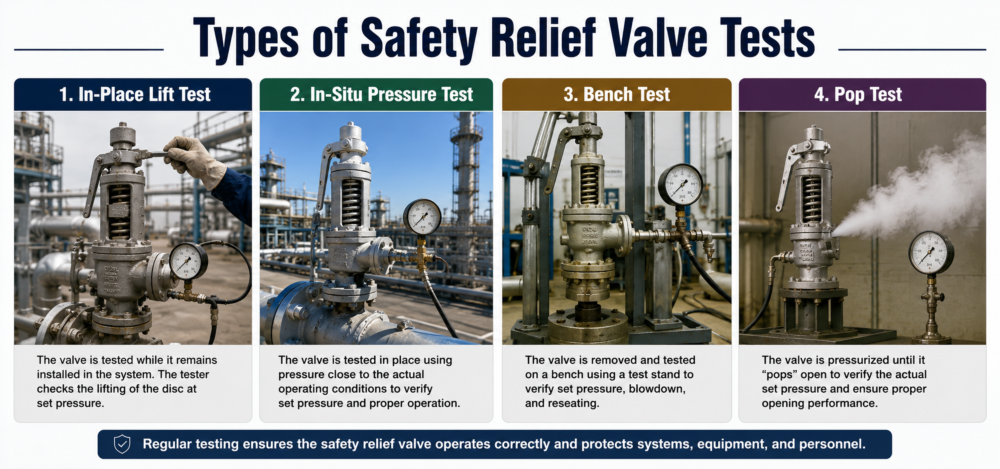
Not all testing methods provide the same level of verification. Depending on regulatory requirements, system criticality, and operating conditions, a safety relief valve may undergo field testing, pressure testing, or certified bench testing.
Understanding the purpose and limitations of each test helps facilities maintain compliance while ensuring reliable overpressure protection.
1. In-Place (Field) Lift Test
The lift test is one of the most common field inspections for a safety relief valve. During the test, the operator manually activates the test lever, typically when system pressure reaches at least 75% of the valve's set pressure, to confirm that the disc lifts freely and discharge occurs as expected.
Key benefits include:
- Verifies the mechanical movement of internal components
- Confirms the valve is not stuck or seized
- Checks for proper reseating after activation
- Supports routine operational inspections
While useful for verifying functionality, a lift test doesn't confirm set-pressure accuracy and should not replace certified testing procedures.
2. In-Situ Pressure Test
An in-situ pressure test evaluates whether the safety relief valve opens at or near its designated set pressure while remaining installed in the system. This method requires controlled pressurization and monitoring by qualified personnel.
Advantages include:
- Verifies actual opening pressure
- Minimizes system downtime
- Allows testing without removing the valve
- Often accepted for annual compliance verification under NBIC guidelines
Because it confirms valve performance under operating conditions, this test provides a more accurate assessment than a basic lift test.
3. Bench (Overhaul) Test
A bench test is the most comprehensive method for evaluating a safety relief valve. The valve is removed from service and tested on a certified test stand under controlled conditions.
During a bench test, technicians verify:
- Opening (set) pressure accuracy
- Blowdown and reseating pressure
- Disc and seat condition
- Spring integrity and calibration
- Leakage performance at operating pressure
Bench testing is typically required after repairs, reconditioning, or major maintenance activities. Testing and repairs must be performed by qualified organizations holding a National Board "VR" certification.
4. Pop Test
A pop test confirms that the safety relief valve opens rapidly and fully at its set pressure rather than gradually "simmering" open. This test is especially important for steam systems, where quick pressure relief is critical for equipment protection.
Pop testing helps verify:
- Proper valve response characteristics
- Full-capacity pressure relief performance
- Compliance with steam-service requirements
- Reduced risk of seat damage caused by simmering
This test is commonly performed on boiler applications and other high-energy steam systems.
How to Choose the Right Safety Relief Valve Testing Method
Selecting the appropriate safety relief valve testing method depends on your equipment type, operating conditions, compliance requirements, and maintenance objectives. While routine lift tests can help verify basic functionality, they may not provide the level of accuracy required for critical applications.
Consider the following factors when determining the best testing approach:
- Regulatory Requirements: Ensure testing procedures meet applicable ASME, NBIC, and jurisdictional standards.
- System Criticality: High-risk boilers, pressure vessels, and process systems often require more comprehensive testing.
- Valve Condition and Age: Older valves or those with a history of performance issues may benefit from bench testing.
- Operating Environment: Corrosive, high-temperature, or high-cycle service conditions may warrant more frequent and detailed inspections.
- Downtime Constraints: In-situ testing may be preferred when removing the valve would significantly disrupt operations.
- Maintenance History: Valves that have undergone repairs or reconditioning typically require certified bench testing before being returned to service.
Many facilities use a combination of testing methods throughout the life of a safety relief valve to balance compliance, reliability, and operational efficiency. Working with qualified valve specialists can help ensure the testing strategy aligns with both regulatory requirements and system performance goals.
Safety Relief Valve Testing vs. Certification: What's the Difference?
Many facility operators use the terms testing and certification interchangeably, but they serve very different purposes. Understanding the distinction is critical for maintaining compliance, satisfying insurance requirements, and ensuring the reliability of safety relief valves.
What is Safety Relief Valve Testing?
Testing is the process of evaluating a safety valve to confirm that it operates as designed. The goal is to verify the valve's ability to protect equipment and personnel during an overpressure event.
Safety relief valve testing typically evaluates:
- Opening (set) pressure accuracy
- Seat tightness and leakage performance
- Blowdown and reseating characteristics
- Mechanical condition of internal components
- Overall valve functionality and response
While testing verifies performance, it doesn't automatically make the valve compliant with regulatory requirements.
What is a Safety Relief Valve Certification?
Certification is the formal documentation and validation of testing results by an authorized organization or qualified inspector. Certification provides proof that the safety relief valve has been tested according to applicable industry standards and regulatory requirements.
NBIC certification typically requires:
- Testing performed by or under the supervision of a National Board-authorized inspector or a VR-stamp holder
- Documentation using approved National Board forms and procedures
- Traceability to calibrated testing equipment
- Proper labeling, stamping, or identification following repair or reconditioning
- Complete maintenance and testing records for compliance verification
Why Certification Matters
For many jurisdictions, insurers, and regulatory agencies, testing alone is not enough. If proper certification records are unavailable, the valve may be considered non-compliant regardless of whether testing was performed.
Key reasons certification is important include:
- Demonstrates compliance with NBIC and jurisdictional requirements
- Supports insurance audits and inspections
- Provides documented proof of valve performance
- Establishes traceability and maintenance history
- Reduces compliance and liability risks
Many facilities rely on trusted products such as the Kunkle safety relief valves and Apollo pressure relief valves because of their proven performance and manufacturing documentation.
However, that documentation only certifies the valve when it leaves the factory. Ongoing testing and certification are still required to verify that the safety relief valve continues to perform safely throughout its service life.
Common Causes of Safety Relief Valve Inspection Failures
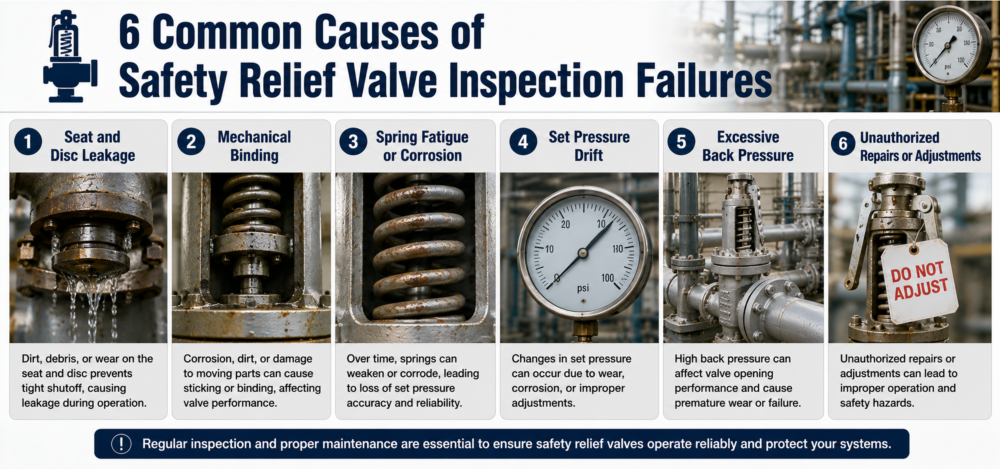
Regular inspections help identify performance issues before they compromise system safety. Understanding the most common causes of safety relief valve failures can help maintenance teams improve inspection programs, reduce unplanned downtime, and maintain regulatory compliance.
The following issues account for a large percentage of failed safety valve inspections:
Seat and Disc Leakage
Corrosion, scale buildup, or debris on the seating surfaces can prevent the valve from sealing properly after activation. This often results in continuous leakage, reduced efficiency, and increased wear on internal components.
Mechanical Binding
Corrosion, rust, or process deposits can restrict the movement of internal parts such as the spindle, guides, or bonnet assembly. A safety relief valve that binds may fail to open during an overpressure event or fail to reseat correctly after discharge.
Spring Fatigue or Corrosion
Spring fatigue can cause set-pressure drift, increasing the risk of premature valve opening or delayed overpressure protection.
Set Pressure Drift
Changes in spring tension, component wear, or corrosion can cause the valve's opening pressure to shift from its original calibration. This may result in:
- Premature valve opening and nuisance trips
- Delayed pressure relief during critical events
- Reduced system reliability and safety
Excessive Back Pressure
Discharge piping configurations can create back pressure that interferes with valve performance. In these situations, a back-pressure regulating valve or a balanced bellows valve design may be necessary to maintain proper operation. For a detailed comparison, see our article on Back Pressure Regulator vs. Relief Valve.
Unauthorized Repairs or Adjustments
Unauthorized disassembly, spring replacement, or field adjustments can alter the performance of a safety relief valve and invalidate its certification. Even minor modifications may create significant set-pressure errors and increase the risk of regulatory non-compliance.
Why Early Detection Matters
Most safety valve failures develop gradually and can be identified through routine inspection and testing. Establishing a proactive maintenance program helps facilities address performance issues before they lead to equipment damage, safety incidents, or costly compliance violations.
How to Inspect a Safety Relief Valve: Step-by-Step Procedure
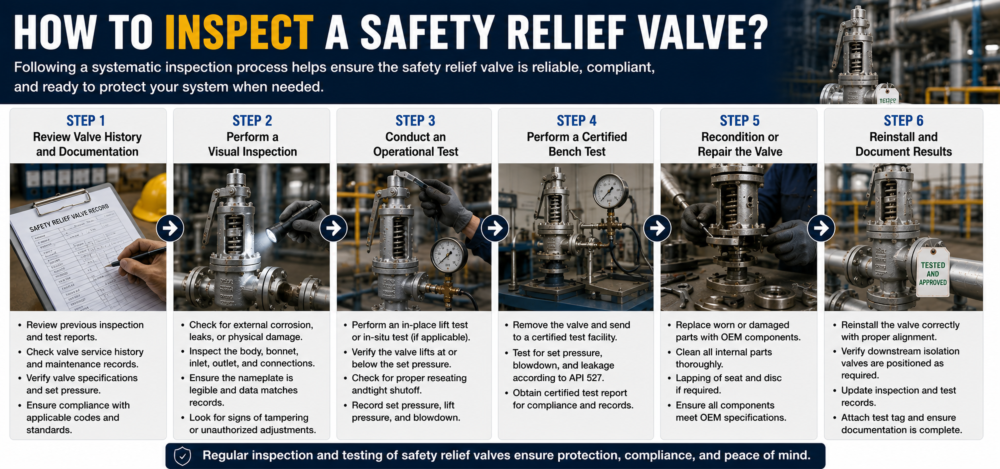
A well-documented inspection program helps ensure every safety relief valve remains compliant, reliable, and ready to respond during an overpressure event.
While specific procedures may vary by application and jurisdiction, most inspections follow a structured process designed to verify valve condition, performance, and certification status.
Step 1: Review Valve History and Documentation
Before beginning the inspection, review all available records for the safety relief valve, including:
- Previous inspection and test reports
- Certification documentation
- Maintenance and repair history
- Valve nameplate information
- Set pressure and capacity ratings
This step helps confirm that the valve is properly sized and approved for its current service conditions.
Step 2: Perform a Visual Inspection
Conduct a thorough external inspection of the safety relief valve and surrounding installation.
Inspect for:
- Corrosion, rust, or physical damage
- Signs of leakage or previous discharge events
- Paint, debris, or obstructions on the lift lever
- Improper discharge piping configurations
- Missing tags, seals, or certification markings
Many potential issues can be identified before operational testing begins.
Step 3: Conduct an Operational Test
Depending on regulatory requirements and system conditions, perform a lift test or in-situ pressure test to verify valve functionality.
Evaluate:
- Valve opening performance
- Mechanical freedom of moving components
- Proper reseating after discharge
- Leakage after closure
Any irregular operation should be documented for further evaluation.
Step 4: Perform a Certified Bench Test (If Required)
If inspection results indicate performance concerns or if regulations require it, the safety relief valve should be removed and tested on a certified test stand.
Bench testing verifies:
- Set pressure accuracy
- Blowdown characteristics
- Seat tightness
- Internal component condition
- Overall valve performance
This provides the most comprehensive assessment of valve integrity.
Step 5: Recondition or Repair the Valve
When deficiencies are identified, the valve may require cleaning, reconditioning, or component replacement.
Common repair activities include:
- Seat lapping and restoration
- Spring replacement
- Guide and spindle cleaning
- Internal component replacement
To maintain certification, repairs and reconditioning must be performed by qualified organizations holding a National Board VR Stamp authorization.
Step 6: Reinstall and Document Results
Once testing and repairs are complete, reinstall the safety relief valve according to ASME and NBIC requirements.
Final documentation should include:
- Inspection and test results
- Repair and maintenance records
- Updated certification information
- Next scheduled inspection date
Accurate documentation is essential for compliance audits, insurance reviews, and long-term asset management.
Integrating Safety Valve Inspections into Plant Maintenance Programs
Facilities that utilize automation and process-control equipment, such as Fisher valves and Honeywell controller systems, should incorporate safety relief valve inspection records into their broader maintenance management programs. Centralized documentation improves traceability, simplifies compliance reporting, and provides a more complete view of overall system reliability.
Safety Relief Valve Documentation and Recordkeeping Requirements
Proper documentation is a critical part of any safety relief valve compliance program. Regulatory agencies, insurance providers, and jurisdictional inspectors rely on accurate records to verify that inspections, testing, repairs, and certifications have been performed according to applicable standards.
Under NBIC requirements, facilities must maintain complete and accessible records for every relief valve in service. These records should be readily available during audits, inspections, or compliance reviews.
Essential documentation includes:
- Valve manufacturer, model number, serial number, and ASME certification information
- Installation date and equipment location
- Inspection and testing dates
- Testing method performed (lift test, in-situ test, bench test, etc.)
- As-found and as-left set pressure measurements
- Inspector name, qualifications, and certification credentials
- Repair organization information, including VR Stamp authorization when applicable
- Details of repairs, adjustments, or replacement components
- Calibration records for testing equipment
- Date of the next required inspection or certification
Why Accurate Recordkeeping Matters
Maintaining detailed records helps facilities:
- Demonstrate compliance with ASME, NBIC, and jurisdictional requirements
- Simplify regulatory and insurance audits
- Track the performance history of each safety relief valve
- Identify recurring maintenance issues
- Improve maintenance planning and asset reliability
- Reduce the risk of missed inspections or expired certifications
Many facilities now use computerized maintenance management systems (CMMS) to monitor inspection schedules, store certification records, and manage compliance across multiple assets and locations.
However, regardless of whether records are maintained digitally or on paper, they should be retained throughout the service life of the equipment and be readily accessible when requested.
Comprehensive recordkeeping also strengthens overall plant safety and maintenance programs. If you are evaluating your current inspection practices, our boiler maintenance checklist offers additional guidance for integrating safety relief valve inspections into a broader preventive maintenance strategy.
How to Choose the Right Safety Relief Valve for Your Application
Selecting the right safety relief valve is one of the most important decisions for maintaining system safety, regulatory compliance, and long-term reliability. Even the most rigorous inspection and testing program cannot compensate for a valve that is incorrectly sized, improperly rated, or unsuitable for the application.
When evaluating a safety valve, consider the following factors:
Set Pressure and Maximum Allowable Working Pressure (MAWP)
The valve's set pressure must be carefully matched to the protected equipment's Maximum Allowable Working Pressure (MAWP). An improperly selected set pressure can lead to nuisance valve activation or inadequate overpressure protection.
Required Relieving Capacity
ASME standards require a safety relief valve to provide sufficient relieving capacity to handle the maximum anticipated pressure source, whether caused by heat input, process upsets, or equipment failure.
Proper sizing helps ensure that:
- System pressure remains within allowable limits
- Equipment is protected during overpressure events
- Regulatory compliance requirements are met
Back Pressure Considerations
Back pressure can significantly affect the performance of a safety relief valve. Conventional valve designs may experience operational issues when discharge piping creates excessive back pressure.
Key considerations include:
- Conventional valves are generally sensitive to elevated back pressure
- Balanced bellows or pilot-operated designs may be required for high back-pressure applications
- A back-pressure regulating valve should be used when process pressure control is required, rather than modifying the relief valve itself
Service Media Requirements
Different applications require different valve designs. A safety relief valve that performs well in steam service may not be suitable for liquid, gas, air, or two-phase flow applications.
Proper media selection helps prevent:
- Valve chatter
- Premature wear
- Seat damage
- Set pressure drift
- Reduced valve life
Material Compatibility
Process conditions often dictate the materials used in a safety valve. Corrosive chemicals, high-purity processes, extreme temperatures, and specialized industrial applications may require upgraded trim materials or specialized valve construction.
Manufacturers such as Conbraco and Velan valves offer a wide range of material options designed to meet demanding industrial requirements and challenging operating environments.
Choosing the right safety relief valve from the start reduces maintenance costs, improves compliance outcomes, and enhances overall system protection. By carefully evaluating pressure requirements, relieving capacity, back pressure conditions, service media, and material compatibility, facilities can build a safer and more reliable pressure-protection strategy.
Safety Relief Valve Maintenance and Compliance Best Practices
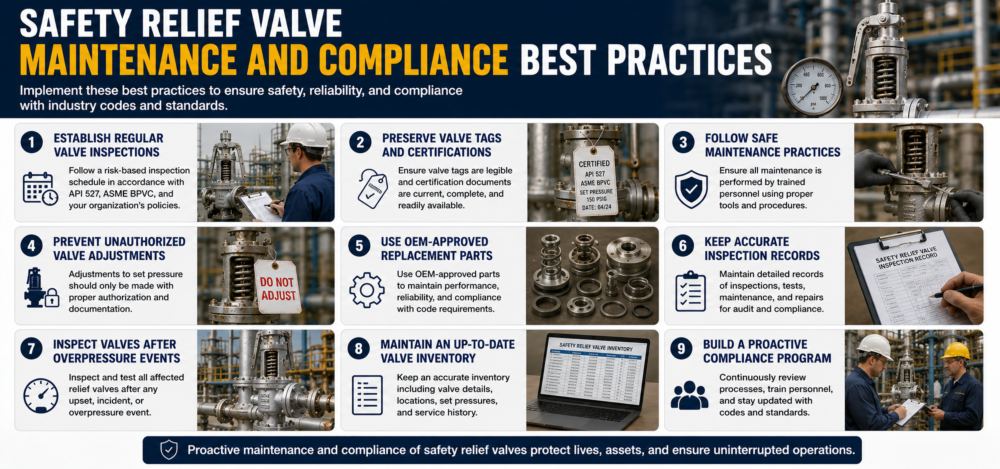
Maintaining a safety relief valve is about more than meeting regulatory requirements; it's about ensuring the valve will operate reliably when an overpressure event occurs. Following proven maintenance and compliance practices helps reduce safety risks, improve equipment reliability, and support long-term regulatory compliance.
The following best practices are widely recommended by ASME, NBIC, and leading valve manufacturers:
Establish a Formal Inspection Program
Create a documented inspection and testing program that clearly defines:
- Inspection and testing intervals
- Responsible personnel
- Documentation requirements
- Compliance procedures
- Corrective action processes
A structured program helps ensure that no relief valve is overlooked.
Preserve Valve Identification and Certification Information
Never paint over or remove:
- Nameplates
- ASME certification markings
- Valve body identification
- Lift levers
- Inspection tags
These markings are essential for compliance, maintenance, and traceability.
Follow Safe Maintenance Procedures
Before performing any work on a safety relief valve:
- Isolate the equipment when appropriate
- Relieve system pressure
- Follow facility lockout/tagout procedures
- Verify safe working conditions
Failure to follow proper procedures can create serious safety hazards.
Avoid Unauthorized Adjustments
Set-pressure adjustments should never be performed in the field by unqualified personnel. Any calibration changes, repairs, or reconditioning activities should be completed by authorized organizations with the appropriate certifications.
Use Approved Replacement Components
Only OEM-approved parts should be used when servicing a safety relief valve.
Using non-approved components may:
- Affect valve performance
- Void certifications
- Create compliance violations
- Increase safety risks
Maintain Clear Inspection Records
Every tested or certified safety valve should be properly documented and identified with:
- Inspection date
- Set pressure information
- Test results
- Certification status
- Next scheduled inspection date
Accurate records simplify audits and improve maintenance planning.
Inspect Valves After an Overpressure Event
If a safety relief valve has opened during an overpressure condition, it should be evaluated before being returned to service. High-pressure discharge can damage seats, springs, and internal components, potentially affecting future performance.
Maintain a Comprehensive Valve Inventory
Develop and maintain an asset inventory that links each safety valve to the equipment it protects.
A comprehensive inventory helps facilities:
- Track inspection schedules
- Manage certifications
- Reduce the risk of missed inspections
- Support compliance audits
- Improve long-term maintenance planning
Building a Proactive Compliance Strategy
The most effective facilities treat safety relief valve maintenance as a proactive reliability program rather than a reactive compliance task. Consistent inspections, proper documentation, qualified repairs, and disciplined maintenance practices help ensure critical pressure-protection devices remain ready to perform when they are needed most.
Get Expert Support for Safety Relief Valve Selection, Testing, and Compliance
A safety relief valve is one of the most critical components in any pressure system, and maintaining compliance requires more than periodic inspections. It demands the right products, technical expertise, proper documentation, and a proactive maintenance strategy.
At Control Specialties, we help industrial facilities select, maintain, and support pressure protection solutions that meet demanding operational and regulatory requirements. From Kunkle safety relief valve products and Apollo pressure relief valve solutions to Conbraco, Velan valves, and other industry-leading brands, our team provides the technical guidance needed to ensure reliable system performance and compliance.
Maintaining compliance requires more than meeting inspection deadlines. It requires selecting the right valve, establishing a testing strategy, documenting results, and addressing deficiencies before they affect system safety.
Whether you are upgrading existing equipment, developing a preventive maintenance program, or addressing inspection and certification requirements, Control Specialties delivers the product knowledge and application expertise to support your goals. Contact our team to discuss your pressure relief requirements and find the right valve solution for your facility.
Frequently Asked Questions (FAQs)
How do I know when a safety relief valve needs to be replaced instead of repaired?
A safety relief valve should be replaced if it has significant seat damage, body corrosion, repeated calibration failures, cracked components, or repair costs that approach replacement value. A qualified valve specialist can evaluate whether repair or replacement is the most cost-effective and compliant option.
Can I upgrade my existing safety relief valve without modifying the entire system?
In many cases, yes. However, any replacement safety relief valve must be properly sized, rated, and compatible with the system's operating conditions, relieving capacity requirements, and applicable ASME or jurisdictional codes. An engineering review is recommended before making changes.
What are the risks of operating with an overdue safety relief valve inspection?
Missing required inspections can lead to regulatory violations, failed audits, insurance complications, unexpected equipment damage, and increased safety risks. More importantly, an untested safety relief valve may not operate correctly during an overpressure event, leaving critical equipment unprotected.
How can I reduce safety relief valve maintenance costs without compromising compliance?
The most effective approach is implementing a preventive maintenance strategy that includes routine inspections, accurate recordkeeping, proper valve selection, and timely repairs. Working with experienced valve specialists can also help identify recurring issues before they become costly failures.
Where can I get expert help selecting the right safety relief valve for my application?
Valve selection depends on pressure requirements, relieving capacity, service media, temperature, material compatibility, and regulatory standards. The team at Control Specialties can help evaluate your application and recommend the most appropriate safety relief valve solution for reliable performance and compliance.
Why do safety relief valves fail inspection?
Safety relief valves commonly fail inspection due to corrosion, worn or damaged internal components, incorrect set pressure, seat leakage, spring fatigue, improper installation, or lack of maintenance. These issues can prevent the valve from opening, reseating, or relieving pressure as designed.